A 34-year-old mother of an infant girl from the Bedouin village in Beit Lahiya, Muna described the hardships of displacement and the harsh conditions in which she gave birth to her daughter:
Before the war, I lived with my husband, Fahed, 34, in the Bedouin village north of the town of Beit Lahiya, very close to the border with Israel. My husband is a poor man, who worked any odd job he could find to provide for us, but despite that, we managed, with great effort, to build a simple, modest house for ourselves, full of love and warmth, which meant everything to us, comfort and security, a sense of belonging and dignity. I also loved Beit Lahiya, a town that was my home, where I dreamed of growing, of raising my children and spending my life in its streets and among its people.
The day the war started marked the beginning of a long ordeal of displacement, full of fear, poverty and suffering, which robbed me of almost everything I had, and the end is still nowhere in sight. Rockets started flying over our heads, and shells exploded around us randomly because of how close we were to the border. On the second day of the war, we fled for our lives without taking anything with us, and since then, we’ve been displaced more than 10 times, each time trying to escape the shelling and the danger. But the war chased us everywhere, without stopping.
At first, we were displaced together with my husband’s family to the Khafsa Bint Omar school, in the al-Falujah area in Jabalya Refugee Camp. Crowds of IDPs were crammed in there, sleeping on the floor in classrooms and corridors, with no privacy and no safety. We didn’t stay there long.
On 18 November 2023, as the shelling intensified and the killing escalated in a way that can’t be described or grasped, my husband decided that we would move south to try to keep ourselves safe. We crossed a-Rashid Street on foot until we reached a-Nuseirat Refugee Camp, and from there, we traveled to the city of Rafah at the southern end of the Strip. We rented a small apartment and stayed there for about a month and a half.
On 3 January 2024, Israel bombed the house next to us, and my husband and I were injured by building debris and evacuated to Abu Yusef a-Najar Hospital. Afterwards, we moved to the Philadelphi Corridor area, near the Egyptian border. We thought we’d be safe there, far from the bombing of houses and from the massacre that was taking place every day and every moment. Life in a tent was very hard, with no privacy and no protection from the cold in winter and the heat in summer.
On 6 May 2024, when the Israeli military began its invasion of Rafah, we fled along with more than a million residents and IDPs who were in the city, and, once again, we looked for a “safe” place. We went to the UNRWA barracks area, west of Rafah. But we stayed there only nine days, because the shelling and killing reached there too. Not an inch was safe in Rafah. My husband decided we would move to al-Mawasi, on the seashore of the city of Khan Yunis, in search of temporary safety. But we didn’t have a tent and didn’t find shelter there. We spread blankets on the sand, and the sky was our cover. For 12 merciless days, we slept on the sand, shivering from the cold at night and burning under the sun’s heat during the day, abandoned to the elements and exposed to everyone’s gaze, and the fear did not let up for a moment.
Every displacement came with hunger, exhaustion, deathly fear and the denial of our most basic human rights. In the meantime, I became pregnant, after four years of trying unsuccessfully to have a child. We were left with nothing, struggling to survive, until January 2025, when a ceasefire was declared between the Palestinian factions and the Israeli military. We thought the killing and displacement ended for good and the war was over, so we walked back to Gaza City in the northern part of the Strip.
But when we returned, we couldn’t find any house that could take us in and give us shelter. When my husband went to check on our home, he discovered that our entire neighborhood had been destroyed and wiped out. The Israeli military took over the entire area of the Bedouin village and turned it into a military base. We didn’t have a home anymore and didn’t know how we would go on living. At that point, I was already pregnant, and my husband and I decided to do everything we could to keep ourselves safe so that we could bring our baby into the world.
On 2 February 2025, I gave birth to my daughter, Kinaz, at al-’Awda Hospital, on a mattress on the floor, in harsh conditions. There were no beds, no privacy and there were hardly any medicines or medical equipment. Knowing that our baby girl, who has never done anything wrong, was starting her life under the sound of shelling was unbearable. My husband was with me at the hospital and slept in the yard in a tent with other men.
We stayed displaced after the birth, too, with no safe place to stay and without essential baby supplies. I stayed at the hospital with Kinaz for about a week, and then we moved to my family’s house in the Beit Lahiya Project. We stayed there for about a month, and then we tried to move to Beit Hanoun and set up a tent there. But very soon, on 18 March 2025, the war started up again, and everything repeated itself, the shelling and the killing, the destruction and the displacement, as if it never stopped.
The Israeli military threatened us using phone calls and dropping leaflets demanding that we leave our homes and move south again, all under shelling, artillery fire, and a massacre that they renewed with even greater force and cruelty than before the ceasefire. We were forced to leave immediately and leave everything behind.
We moved to the western part of Gaza City, to al-Azhar University. We lived in a very small hall with five other families, packed tightly together, for eight months. Eight months that felt like the horrors of Judgment Day, a hellish time, a time of killing, shelling and hunger. In early August 2025, the military announced it had captured Gaza City and ordered all its residents to move south, as it advanced towards us from every direction. I couldn’t bear the thought that my baby daughter was living through all this death.
In early September, after the situation in western Gaza became unbearable and after we spent several days on the street looking for shelter, we were displaced again. After many efforts, we rented, together with my husband’s family, a plot of land in a-Zawaida in the central Gaza Strip, in the a-T’abin area, with seven unrelated families who share this land with us, and we’re still here. We are living in terrible conditions, without enough food, without clothes, without blankets, without furniture and without any safety in our daily lives.
On 10 October 2025, a ceasefire was finally declared, and people started going back to Gaza City again, but we did not go back, because we have no home to return to. I stayed with my husband and his family in IDP tents. We’re all heartbroken, trying to get food and give our little girl a safe life, something that has become almost impossible when winter came without clothes and supplies to protect us from the bitter cold.
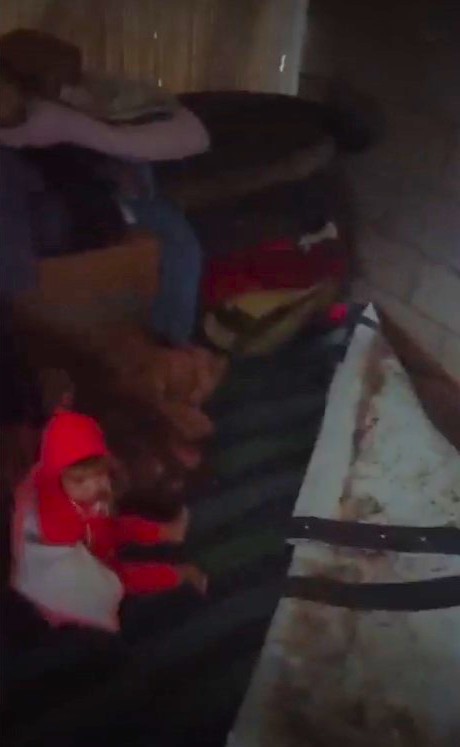
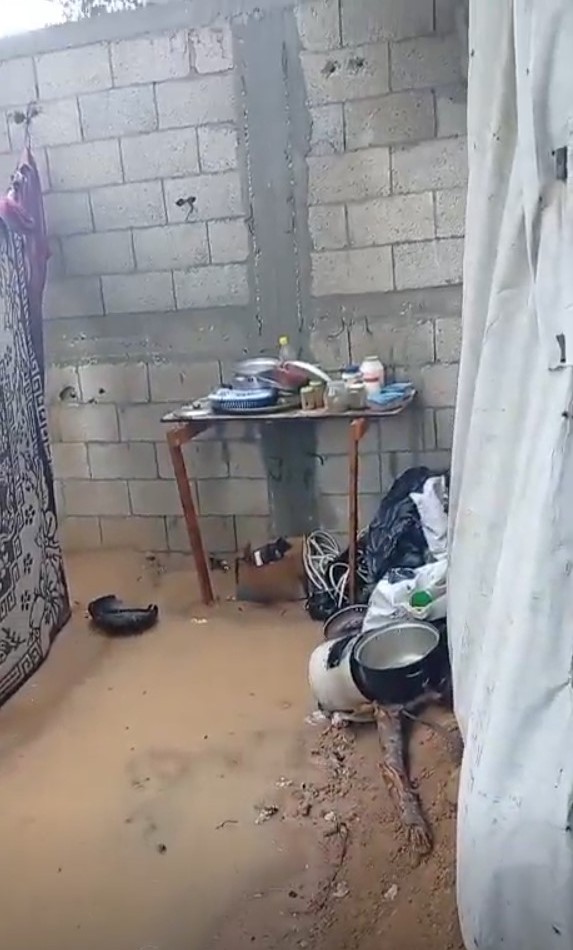
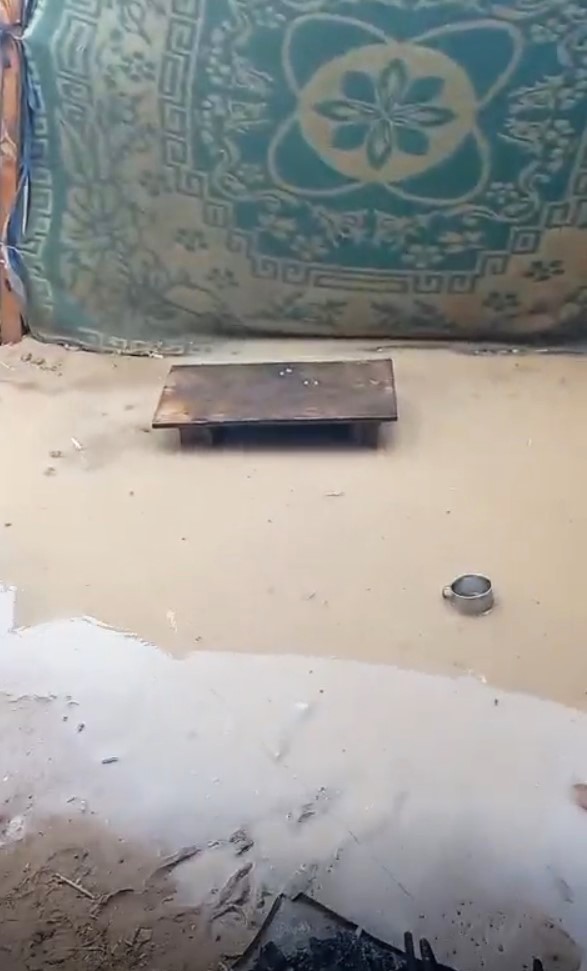
The worst days we went through were during the storm that hit the Strip on 10 December 2025. Our tent could not withstand the strong winds and rain that battered us. The three of us sat inside and felt it start to sway from side to side, and then water started seeping in from the roof and from the ground and flooded everything, the mattresses, the clothes and the food. My husband stood and tried to fix the tent with his bare hands, holding down the corners in an attempt to stop the water from coming in, but he was powerless against the force of the wind and rain. I saw his helplessness. I saw my little daughter shivering with cold, and I burst into tears, crying like I’d never cried in my life. All the pain and humiliation of the war, the displacement, the poverty, the fear, the exposure to the elements with no protection, all of it came together for me in that moment, when we were standing in the water, trying to protect ourselves from drowning inside a shelter made of cardboard and burlap that we called a “home.”
My story is a story of pain, the pain of a mother who carried her daughter in her womb and gave birth to her in wartime, and the pain of a poor husband who is doing everything in his power to protect his family; the pain of children who sleep on sand and under the rain, and the pain of a family that has lost its home, its privacy, its safety and its future. Pain over a life full of humiliation and fear. Today, all I ask for is that the war ends, and that I have a tent that provides shelter for me, my husband and our little girl and protects us from storms and rain.
* Testimony given to B’Tselem field researcher Muhammad Sabah on 28 December 2025
Read more: Clinging to what’s left of life: Palestinian women under genocide in Gaza, 8 March 2026