A 35-year-old father of three from a-Shati Refugee Camp, ‘Arafat spoke about his two-month-old nephew who died of cold exposure, in a ruined house where his family was sheltering in Gaza City
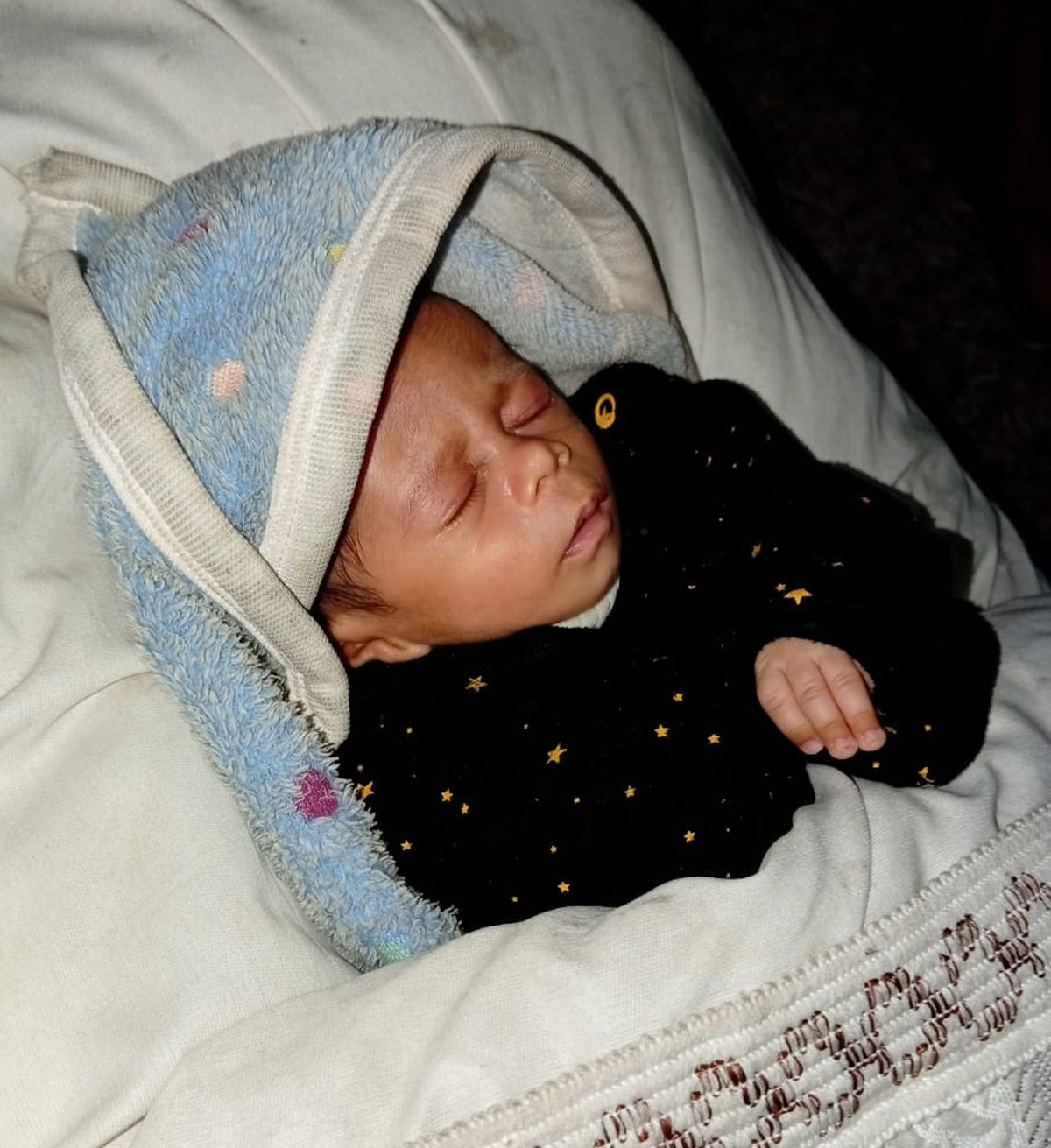
I’m the uncle of Tayyem al-Khawaja, who died at two months old because of the cold.
Until the war, I lived with my wife and our three children in a-Shati Refugee Camp in Gaza City, in a three-story building. My parents and my brother Mahmoud, 27, also lived in the building. We each lived on separate floors, in 200-square-meter apartments. Since then, like all families in Gaza, we have gone through all the hardships of this cruel war.
At the beginning of the war, on 9 November 2023, the Israeli military bombed our neighbors’ home in the camp and several people were killed. So we decided to move to the city of Rafah in southern Gaza. The situation in Rafah was bad and we lived in harsh conditions there.
When the military invaded Rafah in May 2024, we moved to the displaced persons’ camp in al-Mawasi, Khan Yunis. While we were there, on 15 November 2024, my brother Mahmoud married Rawan al-Khawaja, 21. We didn’t hold a wedding party and there was no celebration. We marked the occasion only with close family. We were living in tents in harsh conditions, and the situation was very frightening.
During the ceasefire in January 2025, we went back north to a-Shati R.C. and found our house damaged. We repaired it as much as we could and moved back in. We stayed there even after the war started again in March 2025, much more heavily and brutally than before. We went through days full of panic, anxiety and indescribable stress.
Rawan was pregnant with baby Tayyem at the time. Because of the hunger and shortages in Gaza, she couldn’t take nutritional supplements and vitamins as pregnant women usually do, and her nutrition was poor. There was no milk for her to drink, for example, or eggs, fruit and vegetables to eat.
In September 2025, when the bombing in Gaza City grew heavier, we moved again, this time to Nuseirat Refugee Camp in central Gaza. We stayed in one tent – my family, Mahmoud and Rawan, and my parents. On 9 October 2025, while we were there, we learned that the Israeli military had bombed our home and destroyed it.
During that time, Mahmoud started to feel unwell. Medical tests found that he had cancer, with tumors in his abdomen. We were all in shock. He’s now receiving chemotherapy and is waiting for Israeli permission to go abroad for further treatment. On 15 October 2025, his wife Rawan gave birth to their son Tayyem at Al-Awda Hospital in Nuseirat R.C. Mahmoud was too weak to go to the hospital with her. The baby was born very small, weighing 2 kilograms at most. But thank God, he was healthy.
After Tayyem was born, we decided to go back to Gaza City. It took some time to find a place to live, and eventually we moved in with my uncle and his family, in his home by the Gaza shore. The house was badly damaged in a bombing. Outer and inner walls were destroyed, so the entire house became a single open space. We cleaned it, put up tarpaulininstead of walls and we all started living in it.
Winter started harshly this year, and we’re living in a house with no walls. We’re suffering very badly from the cold. We don’t have enough warm clothes, blankets or mattresses. In such temperatures, you need more than one blanket per person, but we don’t even have that. When we left our home, we took only a few clothes and belongings. After it was bombed, nothing was left. We share blankets and sometimes borrow clothes from friends or neighbors.
When we could, we bought some clothes with the little money we had, for us and for the children, especially for Tayyem. Mahmoud and Rawan worried about Tayyem all the time, and tried to keep him warm with the blankets and clothes we managed to get. I also gave them some of my children’s clothes, but it wasn’t enough in the extreme conditions of a house without walls, exposed to the sea.
On the morning of 11 December 2025, there was a strong storm. The winds were so strong that they tore down the tarps we put up. Suddenly, I heard Rawan screaming. We rushed over and saw her holding Tayyem. His body and face were blue. He wasn’t breathing and looked lifeless. I immediately took him to a-Shifaa Hospital. When I got there, the doctors checked him and said he was suffering from low blood sugar due to extreme cold, and also had a bacterial infection. He was admitted to the ICU and I stayed with him.
Mahmoud and Rawan didn’t come with me to the hospital, because Mahmoud himself was very ill. At first, the doctors told me Tayyem’s condition was improving. But at 9:00 P.M., they told me he had died. I couldn’t believe it.
Telling Mahmoud and Rawan that Tayyem was dead was a very difficult moment. Mahmoud said to me, “Take him straight to the cemetery. Don’t bring him home. I can’t bear the pain of saying goodbye.” But Rawan insisted that we bring him home so she could say goodbye.
The next day, I went back to a-Shifaa Hospital with my father to get Tayyem’s body. Mahmoud and Rawan didn’t come. We buried Tayyem without bringing him home.
We’re still living in this house with no shelter from the wind, and it’s terribly cold. Mahmoud and Rawan are in mourning and deep grief over the death of their only son. My parents, my wife and I are by their side, comforting and supporting them.
That’s our situation here in Gaza. We’re stuck in horrific, cruel conditions, living in a cycle of loss, grief, injustice and heartbreak over the deaths of our children and other loved ones.
* Testimony given to B’Tselem field researcher Olfat al-Kurd on 18 December 2025