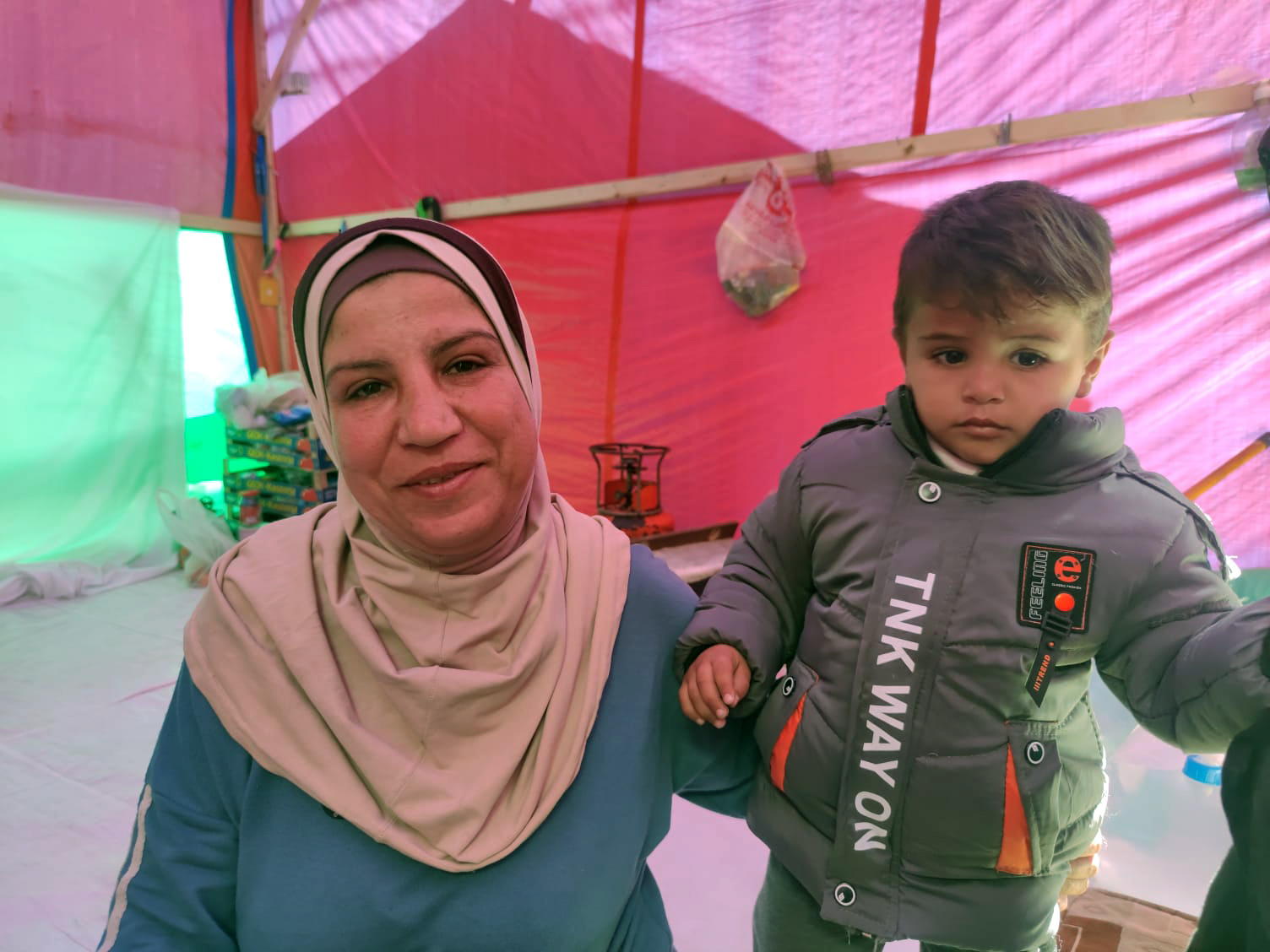
A 45-year-old mother of nine from Beit Hanoun, Amneh described being repeatedly displaced and harsh conditions at a Rafah IDP camp:
On 7 October 2023, our whole family left our home in Beit Hanoun because it was very close to the border with Israel, and we were afraid the Israeli military would shell us. There are 12 of us: myself, my husband Hafez, our seven children, one of my daughters-in-law and my two grandchildren. At first, we fled to my daughter Rawan’s house on al-Jalaa Street in Gaza City. We stayed there for three days, until the Israeli military ordered us to vacate the building. Then we moved to UNRWA Salah a-Din School. We stayed there for another three days, until 13 October, when the military once again ordered us to evacuate and head south. We did as they told us and arrived that day at an UNRWA displaced persons’ camp in Khan Yunis.
We stayed in that camp for three months, in terrible conditions. There was no water, gas or electricity, and we didn’t have enough money to buy wood for cooking or baking bread. All the essential goods were unbelievably expensive, and we survived on canned hummus, beans and lentils. That diet gave us stomach aches, diarrhea and vomiting.
After three months, the military invaded the camp and ordered us to leave again, this time to Rafah. Before we managed to leave, they started shelling and my son ‘Abbas, 17, was hit by shrapnel in the shoulder and back. No ambulances could reach us, but there was a doctor at the UNRWA center who treated his wounds and cleaned them. As soon as he was done we ran out of there, leaving behind all our belongings, blankets, mattresses and remaining food. We were afraid to stay even a moment longer. When we reached the exit from the camp we were delayed anyway, because the Israeli military put up two checkpoints there, one for women and children and another for men. We stood at those checkpoints, in the rain, for about two hours.
In the end, we reached Rafah and set up a makeshift plastic tent on the street. There are about 20 of us in the tent, including 10 children. I can’t even describe how bad it is. We don’t have water suitable for drinking or bathing here, either, and no electricity. We dug a hole in the ground instead of a toilet. There’s a shortage of meat, milk and eggs, and we still survive all week only on what we get from aid organizations: canned hummus and beans, a bit of flour, oil and sugar, and sometimes biscuits. Sometimes we also get something cooked that the aid organizations prepare here. Most of the time, we’re hungry, especially the children. We try to satisfy their hunger with small sandwiches with za’atar and cheese provided by aid organizations. My grandson Haitham, 2, sometimes wakes up at night asking for food, and we don't always have something to give him. We have to make do with what we have. We don’t have money to buy milk or diapers for the children. It’s too expensive.
I miss our old life, before the war, without all the bombings and killings. We’re exhausted. We’re broken and have no strength left. In one of the bombings, I lost a lot of people form my family and my parents were spared by luck alone. Now, the military might invade Rafah and force us out again. I don't know where else we can run. We’ve been displaced four times. I don’t know what fate awaits us. Every area in the Gaza Strip is dangerous, nowhere is safe anymore. I hope this war ends, that they don’t invade Rafah, and that they stop slaughtering us here.
* Testimony given to B’Tselem field researcher Olfat al-Kurd on 18 February 2024