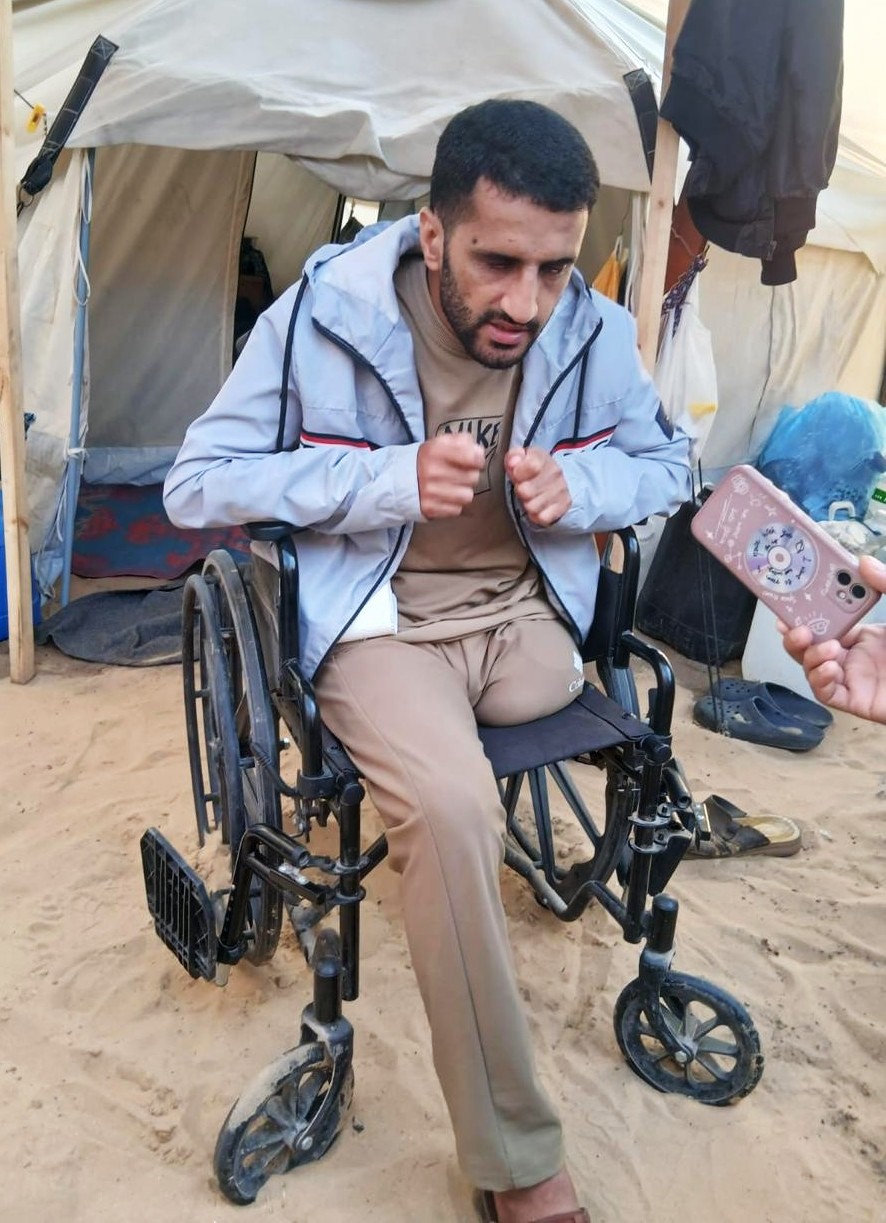
Until the war started, I lived with my parents and my six brothers and sisters near Kamal Adwan Hospital in Beit Lahiya.
During the 2014 war [Operation Protective Edge], I was wounded by shrapnel in an Israeli airstrike on the market area in Jabalya Refugee Camp. Because my injury was so severe, I was hospitalized for three months at a-Najah Hospital in Nablus. I had surgeries, and my leg was amputated. On my way back to Gaza from the hospital in Nablus, I was arrested at Erez Checkpoint and held for two years in the Negev [Ketziot] Prison.
After the war broke out in October 2023, homes were heavily bombed in the northern Gaza Strip. Because our house is close to Kamal Adwan Hospital, I saw the huge number of wounded people and bodies brought there. The situation was very dangerous and frightening. Because the bombing was so heavy, we left home and went to shelter in the hospital. We stayed there for about a month and a half, sleeping in the corridor. The bombings never stopped that whole time, and the fire raged all around us.
We fled from the hospital to the home of my father’s family in Jabalya Refugee Camp, where the situation was a bit less dangerous. We stayed there from December 2023 to the end of May 2024. It was a very difficult time, because we were trapped in the camp and suffered from hunger and thirst. Every morning my brothers went out to look for something for us to eat, because my family is poor and the war left us with nothing.
The soldiers pushed me down to the ground, stepped on me and hit me all over my body. I couldn’t stand up on my own because of my amputated leg, and other detainees helped me to my feet. There were moments when I thought I was close to death from the force of the beating.
On 6 October 2024, another Israeli invasion into Jabalya Refugee Camp began. The bombings and artillery strikes grew heavier, and the situation in the camp became very frightening. We fled again and went back to Kamal Adwan Hospital, where we sheltered until 21 December 2024, when the military surrounded the hospital from all sides for a week.
On 27 December 2024, the military called out on loudspeakers for all the men, women and children to come out of the hospital, except for patients and medical teams. I went out with everyone else. I was thin and exhausted and could barely hobble along on my crutches. When I got close to the military checkpoint, a soldier called me over and ordered me to strip and move ahead. The soldiers violently tied my hands behind my back and started beating me badly, including with their guns. They kicked me until I fell down. They stepped on my face with their boots, and I bled from my face and nose until my vision went blurry.
The soldiers blindfolded me and took me, along with other detainees, to the Zikim area in the northern Gaza Strip. From there, they drove us by bus to the Sde Teiman detention camp. When we got there, they beat us brutally again. One of the soldiers grabbed me and slammed my head over and over against the side of the bus, while other soldiers hit me in the chest until I felt my ribs break, and every breath became unbearable. I was very afraid.
The soldiers pushed me down to the ground, stepped on me and hit me all over my body. I couldn’t stand up on my own because of my amputated leg, and other detainees helped me to my feet. There were moments when I thought I was close to death from the force of the beating.
For six months, I endured severe, relentless torture at Sde Teiman. I was beaten every day. I cried from the pain and begged for medical treatment, but it didn’t help. I was interrogated during my detention. A Shin Bet officer asked me how my leg was cut off, and I said it was the result of an airstrike on the market in Jabalya. He accused me of collaborating with the resistance. I asked him how I could possibly collaborate as an amputee who can barely stand or walk. The interrogator hit me hard on the amputated leg until it bled, and then hit me in the face until I passed out.
When I came to, I couldn’t see anything. I couldn’t open my eyes, and they hurt terribly. I started crying. Someone told me he was a doctor, and that I was in a hospital. He said to me in Arabic: “You’re blind, son of a bitch. You’ll never see again.”
When I came to, I couldn’t see anything. I couldn’t open my eyes, and they hurt terribly. I started crying. Someone told me he was a doctor, and that I was in a hospital. He said to me in Arabic: “You’re blind, son of a bitch. You’ll never see again.” I cried and screamed and begged for treatment, but no one helped me and I was sent back to Sde Teiman.
After some more time in Sde Teiman, one day soldiers dragged me along the ground and put me in a narrow cell, like a coffin. One of them said to me: “We’re going to leave you in this coffin until you die, son of a bitch.” I was terrified and thought they were going to kill me. I stayed locked in that coffin for several days, completely isolated, without food and with almost no water. Every time I shouted and begged for water or food, the soldiers opened the door, beat me hard and shut it again. When I needed the bathroom, I called out to the soldiers, but they ignored me. I tried to hold it in, but in the end I was forced to wet myself. The soldiers opened the coffin from time to time just to see if I was still alive. Later, I almost stopped calling them altogether, because I knew what happened every time the door opened.
During the time I was locked in the coffin, I thought I was going to die. I was alone in a closed space, with no way of knowing whether it was day or night outside, and it was very cold. The smell inside was disgusting, partly because my clothes were soaked with urine. Almost no air came into the narrow, closed cell, which made it hard for me to breathe, on top of my chest injury from the beatings. I felt that my humanity was taken away. I went through very frightening moments inside that coffin. I felt they wanted me to die there, without anyone knowing what happened to me.
A soldier said to me: “We’re going to leave you in this coffin until you die, son of a bitch.” I was terrified and thought they were going to kill me. I stayed locked in that coffin for several days, completely isolated, without food and with almost no water.
After they took me out of the coffin and put me back in the cell, I couldn’t walk because of the beatings, and the loss of my eyesight together with my disability. When I needed to use the bathroom, other detainees helped me: they led me there, waited for me at the door, then took me to the tap and helped me wash my hands and face. They helped me with eating, too, and with every basic need I had. I was completely dependent on them.
Every time I heard a soldier approaching, I asked him to take me to a doctor.
After six months of torture at Sde Teiman, I was transferred to Ofer Prison. There I was abused some more, beaten, attacked by dogs and threatened. My medical condition was so serious that I went on a hunger strike to get treatment. The strike didn’t help, and the soldiers refused to let me see a doctor. I threatened to kill myself, and an officer told me they would get me treatment, but it never happened.
On 10 October 2025, Red Cross representatives came to the prison and told us there was a ceasefire and that we were going to be released. I was transferred from Ofer to Negev [Ketziot] Prison, where I was held for three days, and from there we were taken to Karam Abu Salem [Kerem Shalom] Crossing. We entered the Gaza Strip and were taken to Nasser Hospital in Khan Yunis. My family was waiting for me there, but I arrived in very bad shape, after losing my eyesight.
Now, I’m staying with my family in an IDP tent on a-Zawaydah beach, because we lost our home in the war. I’m still suffering from the effects of the torture. My back hurts badly and my eyes are inflamed. I went to a lot of hospitals for help – the American Hospital, Hamad Hospital and the eye hospital in Gaza City – but all the doctors told me my condition is serious and there is no treatment available in the Strip. They advised me to leave Gaza for medical treatment abroad.
* Testimony given to B’Tselem field researcher Khaled al-‘Azayzeh on 18 November 2025
