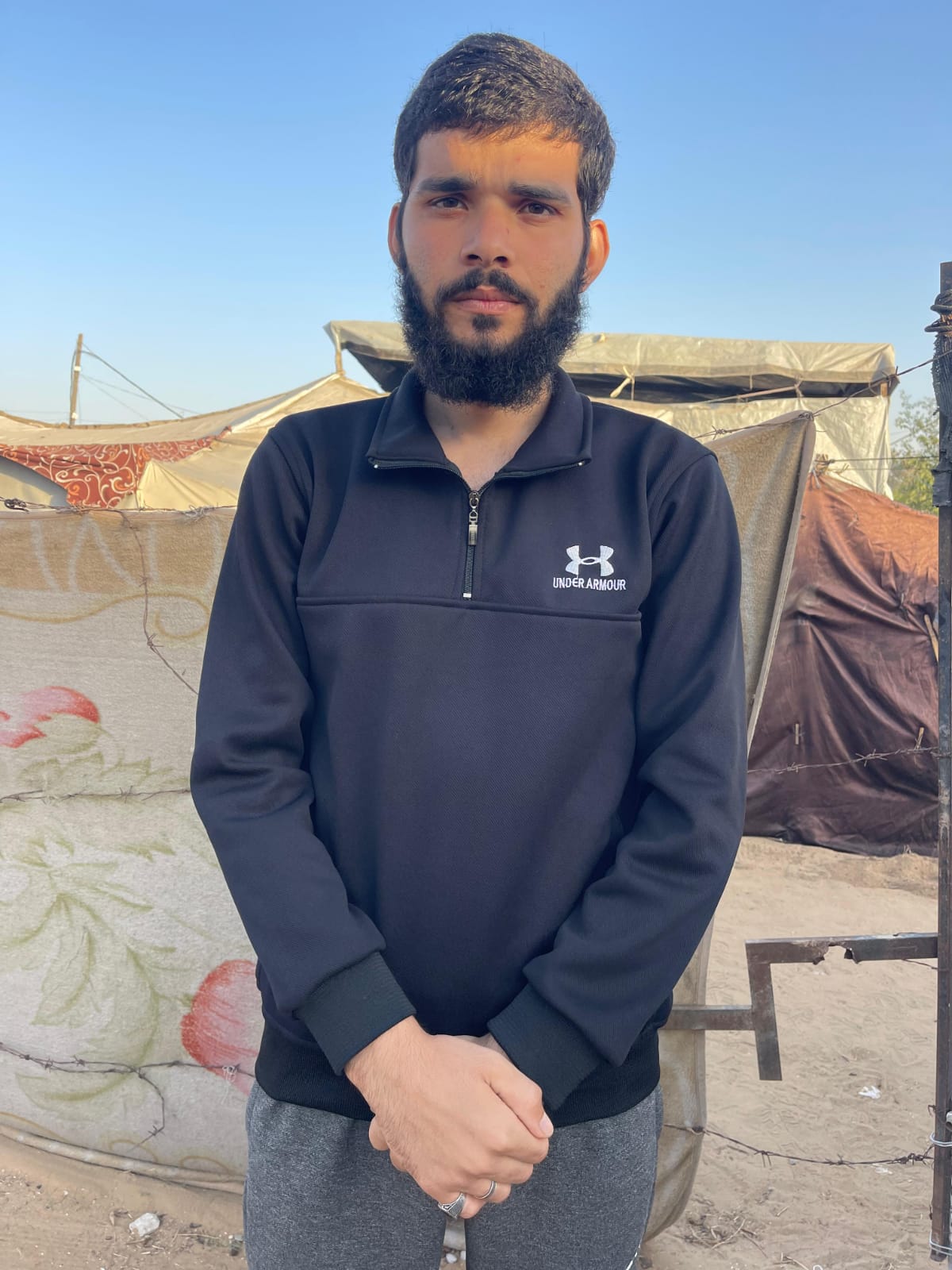
6 October 2023 was a very emotional day for me, because my wedding party was supposed to take place the next evening. We had already signed the marriage contract and were officially married. That morning, I drove my wife to the hair salon and then went home to get ready and go to my barber. At 1:00 P.M., I went back to her place, and we went together to the wedding photo shoot. From there, I took her to the hall where her henna party was held, which went on until 5:00 P.M. Afterwards, I went home for my bachelor party, which started at 6:00 P.M. and lasted until midnight. Everything was joyful and happy.
The next morning, I was in shock. I woke up to the sound of missiles and thought it was probably another escalation. Ten minutes later, I checked the news and realized how serious the situation was: I heard that armed Palestinian operatives had breached the border. I called my wife and told her we would have to cancel the wedding party, because my family and I were going to leave Beit Hanoun. We found shelter in schools in Jabalya Refugee Camp, and my wife told me that she and her family would move to their apartment in the Tel a-Za’atar neighborhood, which is also in Jabalya. The situation was difficult and got worse by the day. There were bombardments, and many people were killed and displaced. After about a month, my wife joined me at the school where we had found shelter. Despite everything, we were happy to be together. Things went on like that until the army raided the school on 11 December 2023.
They tied our hands behind our backs with metal wire, blindfolded us and beat us heavily. They forced us to walk for about a kilometer, beating us along the way […].
The soldiers ordered us, men and boys over 16, to come out of the school together and stand in a line. A soldier ordered us to strip down to our underwear. They tied our hands behind our backs with metal wire, blindfolded us and beat us severely. They forced us to walk for about a kilometer, beating us along the way, until we reached a vehicle, I’m not sure if it was an APC or a truck, and loaded us onto it. They drove us to a military post in the Zikim area on the seashore. They kept us there until about 2:00 A.M., and the whole time they beat, cursed and humiliated us.
After that, a soldier came, asked us our names and ages, and we were photographed naked, in our underwear. At about 4:00 A.M., they took us to Erez Crossing, where I was put in a room with about ten other men. Then I was taken, and a soldier started asking me questions: what I did on 7 October, where I was, and whether I belonged to Islamic Jihad or Hamas. I told him I was not an operative and didn’t belong to any organization, and that I was a construction worker and house painter. The whole time, the soldier beat me, including in my genitals, and called me a liar. He had a metal object in his hand and used it to burn my shoulder. I still have scars there from the burns.
After that, I was taken back to the room and beaten on the way. We weren’t given anything to eat or drink that day. We were kept naked in the cold.
They put us in the sheds, gave us gray uniforms to wear, tied our hands in front of us and ordered us to kneel on the ground. They told us we weren’t allowed to sleep or move until they gave us an order to do so.
Then we were taken in buses, where the soldiers tasered us. At around 3:00 P.M., we arrived at a compound of barracks. Only much later, about six months afterwards, did I understand that the place was called Sde Teiman Prison. They put us inside the barracks, gave us gray uniforms to wear, tied our hands in front and ordered us to kneel on the ground. They told us we weren’t allowed to sleep or move until they gave us an order to do so. We stayed kneeling until midnight, and then a soldier came and told us to go to sleep. We didn’t get any food or water that day.
The moment we arrived at Sde Teiman, the soldiers made one of the detainees as “shawish”, who served as a go-between and interpreter between us and them. He got us water after we begged the soldiers. I was held there, handcuffed and blindfolded, for about 18 days. It was very cold, and we were not allowed to use blankets during the day. In some places, instead of walls, the barracks were enclosed with wire fencing, which let the cold in. The mattress and blanket were too thin and not enough to keep us warm. We had to ask the soldiers for permission to go to the bathroom. A soldier guarding us would take us there, and we were not allowed to be alone even while using it. We got very little food: our three daily meals, breakfast, lunch and dinner, consisted only of a small piece of tuna and a slice of bread.
There were many raids by soldiers, and they didn’t come at fixed times. During the raids, they ordered us to lie on the ground with our hands on our heads while 40–50 soldiers barged in with dogs and beat us with their guns, while the dogs stepped on us. Any detainee who moved was punished. They would make him stand and shackle him to a barbed wire fence. One detainee, who had a leg injury, asked to see a doctor, and then the soldiers took him outside, left him in the rain and beat him. We could hear him screaming.
In one of the interrogations, the officer asked me about my neighbors and relatives. I told him I didn’t know these things about them, that I didn’t ask anyone what they did for a living. I told the officer I go to work in the morning and come back in the evening, and that I don’t socialize with anyone in between. He said, “I want to take you to a better place.”
The interrogator said, “You’re a liar, and you’re lying to us. You helped provide food and transfer water to Hamas. I’m going to execute you.”
I was transferred to Ashkelon Prison (Shikma). When I arrived, a doctor examined me and asked if I had any chronic illnesses. I said I didn’t. He took me to a photography room with another guard, where they took my photo and the other detainees’ photos. Then, I was led to a place surrounded by barbed wire, where they beat me. After that, they took me to an interrogator who asked for my personal information, and from there to a solitary confinement cell.
Two days later, they took me to an interrogator again, and he asked me if I had helped Hamas fighters on the day they crossed the border. I told him I had done no such thing, and he said I would have to take a polygraph test. I told him I was sure of what I was saying. They hooked me up to the polygraph machine, and the first question was: “Did you harm Jews inside Israel?” I said no. “Outside Israel?” I said no. “Did you provide food to Hamas?” I said no. The interrogator said, “You are a liar, and you’re lying to us. You helped provide food and water to Hamas. I am going to execute you.” He threatened me. After that, they took me back to the cell and gave me food. I was so scared that I couldn’t eat anything that day.
One prisoner was bleeding from the rectum. I asked him what caused the bleeding, and he told me he’d been anally raped with a stick during interrogation. Another guy […] told me that during the interrogation, a female interrogator had made cuts to his penis.
The next day, I was taken back for interrogation. There were five interrogators there, and they tightened the shackles on my hands so much that I lost feeling in them. They tied my legs to a chair in a “banana” position. All the soldiers in the room attacked me and beat me on my back, chest, legs and even my testicles. I felt as if my bladder was going to burst. I screamed and told them I needed to urinate. They ordered two guards to take me to the bathroom. When I got there, I was in a state of shock and couldn’t urinate. When I finally managed to, there was a lot of blood in my urine. The guards saw it and told the interrogators, and they put a white pill under my tongue. I nearly lost consciousness. They took me back to the interrogation and kept beating me, in the face and on my ear, until it bled. I told them to write down what they wanted me to say, and then I confessed to something I didn’t do to make them stop. Afterwards, they took me to a place where there were 15 detainees from Gaza. A man came in and introduced himself as a sentenced prisoner named Abu Ahmad. He said his family had been killed in Gaza. Later, I realized he was probably from the Shin Bet. He asked me, “What was the first lie you told the intelligence officers?” I told him I lied when I said I had provided food to Hamas and to the hostages, and that I confessed to something I didn’t do because of the severe beating that made me urinate blood. He said, “You must be proud of yourself.” Afterwards, they took me back to interrogation with the Shin Bet officer. He said to me, “Are you an idiot, confessing to things you didn’t do?” I said I had confessed under beatings and torture, and then they stopped accusing me of those things.
After that, I was transferred to another wing in Ashkelon Prison, where I met detainees from Gaza in worse condition than me. One detainee was bleeding from his rectum. I asked him what the bleeding was from, and he told me he had been anally raped with a stick during interrogation. Another detainee nearby was also in very poor health. He told me that during interrogation, a female interrogator had cut his genitals. I met other people who said their genitals had been harmed in Ashkelon Prison.
Every day, the guards searched the cells. They would come in with sticks, tie our hands, beat us, mainly on the head, then take us out of the cells and search them. When they brought us back in, they beat us again. I stayed in Ashkelon Prison until 21 February 2024.
From Ashkelon, I was transferred to Nafha Prison in the Negev. There were 28 detainees, and on the day of the transfer, they first ordered us to undress and put us in a room, naked, where they searched us with a metal detector. During that search, they hit me in the testicles several times while I was handcuffed. One of the soldiers hit us in the face with metal handcuffs.
When we arrived at Nafha Prison, we were ordered to undress and we were taken into a shower room, where the soldiers kicked us in the testicles with their military boots and beat us with metal tools. They beat us so hard that there was a pool of blood under us. What they did to us that day was so horrible that I cannot describe it. I was also beaten on the arm, which was badly injured and hurt a lot. I tried to keep it tied up and supported with my shirt afterwards.
They first ordered us to strip and put us in a room where they searched us, naked, with a metal detector. During that search, they hit me on the testicles several times […].
They put me in Wing 13. I hoped that maybe things there would be calmer and there would be no more torture, but they put us in a small cell with sealed windows that was completely dark, with only a small opening in the door for passing food, covered with mesh. The next morning, about ten guards came into the cell, beat us severely and took away our mattresses. During roll call, they stripped us and dressed us in very thin brown clothes, even though it was very cold.
In Nafha Prison, we were beaten a lot every day. We got no medical treatment; on the contrary, they just kept beating us. On one occasion, my arm was apparently broken from the beatings. I was taken to a doctor, and on the way there, the officer asked me how I had broken my arm. I told him it had been broken from the beatings, and he told me to tell the doctor I had fallen off the bed and broken it. I told him that was not true, that it had broken from the beatings, but he said that if I didn’t say what he told me to, he would take me back to the room without treatment. I had to tell the doctor I had fallen off the bed. The doctor x-rayed my arm and recorded that I had received treatment, which was only a bandage.
Every two detainees shared one blanket. At some point, one of the detainees got scabies, and the others refused to sleep next to him so as not to get infected. I slept next to him, and we shared a blanket, and two days later, I caught scabies. I was in very bad shape. There was no soap in the shower room, no towels or change of clothes, and we had to put the same clothes back on after showering. I stayed like that until May 2024, when they transferred me to another wing and the doctor who examined me gave me dish soap, which I had to use. That month, one of the detainees who met with his lawyer told me there was media pressure to improve conditions in the prisons. Things did improve a little, and they started giving us ointment to treat the scabies.
The whole time in Nafha Prison, we were subjected to repression. Soldiers came in with dogs, beat us, and the dogs urinated on us and on the food. Not a day went by without beatings and repression.
At Ketziot, I heard shouting and shots fired in the cell next to us. Then they took us all out to the yard and I found out the soldiers had sprayed the inmates in that cell with tear gas and fired rubber bullets at them.
On 17 March 2025, I was transferred to Negev Prison (Ketziot). During the transfer, they beat us with a belt, on the face and hands. The beatings were brutal. When we arrived at the prison, we were in complete shock, because instead of beating us, they fired rubber bullets at us.
30 September 2025 was a very difficult day. One of the detainees, named Kamel al-‘Ajrami, 70, who had diabetes, had been in my cell in Nafha Prison and took many medications. He didn’t always get them regularly, and sometimes they suddenly switched his medications. He was in very poor health. That day, I heard shouting and shots in the cell next to us. Then, they took us all out into the yard, where I found out that the soldiers sprayed the inmates in that cell with tear gas and shot rubber bullets at them. Five detainees were injured, including Kamel, and I saw that he was wounded in several parts of his body.
After that, they took us out to the yard. I looked at Kamel and saw that a prison medic was examining him. I realized he was in bad shape. Then they put us back in the cells, and the detainees who were with us in the cell shouted to the guards that his condition was very serious. I asked the detainees who were right next to him how he was, and they told me he was urinating on himself and couldn’t speak. One of the detainees there, who is a nurse by profession, tried to help him, but there were no supplies. At night, the guard came in and the detainees told him that Kamel’s condition was bad and that he was dying. The guard replied, “Is he dying? What can I do? You have done worse things to us!” He left without doing anything for Kamel. The detainee who is a nurse told the guard that Kamel was literally taking his last breaths. The guard called a doctor, who came and examined Kamel, then put him in a wheelchair and took him out of the room. I found out he died only after I was released.
On Friday, 10 October 2025, I was transferred with two other detainees to another wing, and we were told it was because we were about to be released. They took me to a Shin Bet interrogation, where they threatened to kill me if I cooperated with Hamas. Afterwards, people from the Red Cross came to take our information.
On 13 October 2025, the day of my release, at 4:00 A.M., they handcuffed us, beat us and put us on a bus. On the way, I fell to the ground, and a soldier dragged me to the bus door. We waited inside the bus until 11:00 A.M., and then they drove us to Kerem Abu Salem Crossing (Kerem Shalom). We arrived at 1:00 P.M. When we entered the Gaza Strip, we saw the extent of the destruction. I didn’t expect it to be like that. The tears of joy in our eyes turned into tears of sorrow. We were taken to Nasser Hospital, where I saw my family and my wife. It was a happy reunion. Then, I went with them to Deir al-Balah. I was in shock when I realized there was nowhere my wife and I could stay together, not even a tent. I stayed with my family, and she stayed in a school with hers.
I’ve been in western Gaza City with my family for two days now. My wife and her family have also returned north and are in a school in Gaza City. We don’t have a tent where my wife and I can live together. Our situation is difficult.
* Testimony given to B’Tselem field researcher Olfat al-Kurd on 18 November 2025
