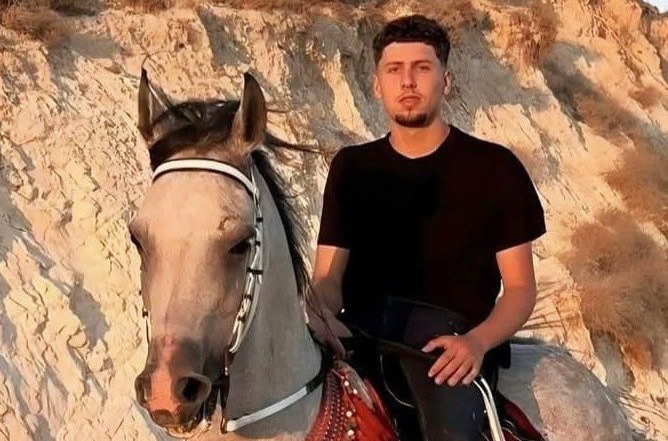
On Wednesday, 18 February 2026, the second day of Ramadan, at around 2:00 P.M., two settlers led a herd of cattle to two sheep farms on the outskirts of the village of Mikhmas, southeast of the city of Ramallah. The settlers, one of them about 15 years old, chased after 'Ayed Abu ‘Ali, 52, the owner of one of the farms, who was grazing his sheep near it. The teen threatened Abu ‘Ali and his flock with a stick, while the other settler filmed what was happening. The two then threw stones at Abu ‘Ali and the sheep. At that point, Abu ‘Ali’s son Mu’aiad, 22, arrived and tried to protect his father and the flock.
Roughly 10 minutes after the settlers arrived, about 15 village residents came to Abu ‘Ali’s aid, and two more settlers arrived as well. One of them, known to the residents as Eliyahu, was carrying a handgun, and the other, known to them as Amir, the security guard of a nearby settlement, had an M-16 rifle. At that point, the teen smashed the window of Mu’aiad Abu ‘Ali’s car, and the settler known as Amir fired 20-30 shots in the air to drive the family members and other residents away.
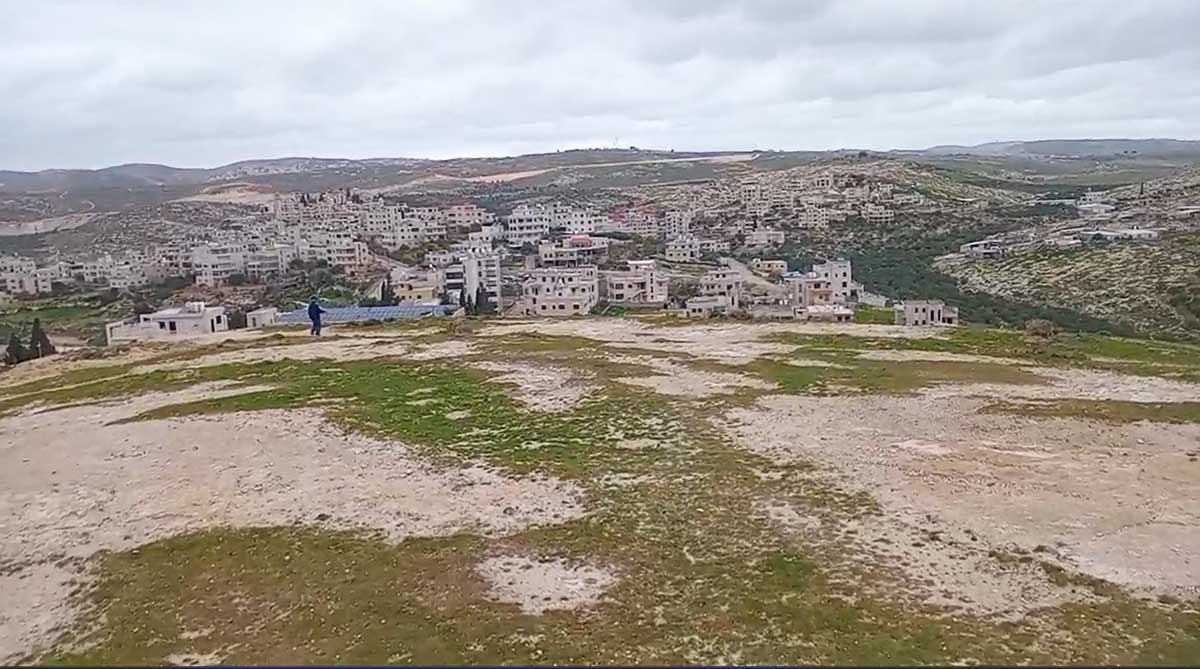
The village residents retreated towards the houses, where they were joined by about 10 other locals, including Nasrallah Abu Siyam, 19. At that point, two masked settlers came from the direction of a nearby hill known as al-Qubah and began throwing stones at the residents, injuring Abu Siyam on the side of his body. Soon after, soldiers arrived in four military jeeps and fired tear gas canisters at the residents, who withdrew from the area, some towards village homes and others towards al-Qubah Hill. The settlers, meanwhile, broke into the farms and entered the livestock enclosures. When the residents tried to head back to the farms to keep the sheep from being stolen, the soldiers fired tear gas and live ammunition at them and protected the thieves, enabling them to steal hundreds of sheep from the two farms.
At around 2:30 P.M., the residents who had fled to the hill came across a group of about seven masked settlers who chased them there from the direction of Abu ‘Ali’s farm. Two of the settlers were armed with M-16 rifles, one with a handgun, and the rest with clubs. One of the settlers knelt in a sniper position and fired at the group of young Palestinians from a distance of about 50 meters. The young men began running down the hill, but one of them, A., was shot in the leg and taken to a hospital in Ramallah, where he was diagnosed with a fracture.
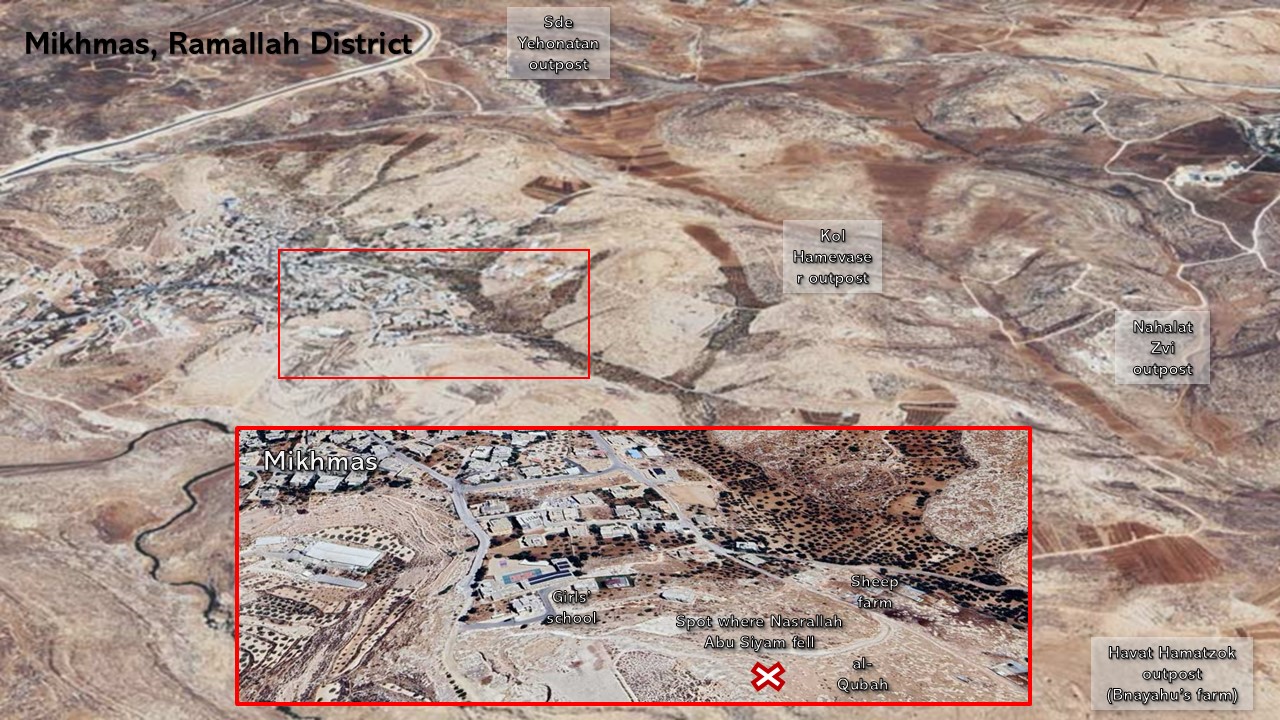
Meanwhile, another group of residents noticed that about 15 sheep had got away when the settlers took the flock out of the pens and went up the hill, and several residents went there to retrieve them. At the top of the hill, they also came across settlers, and some of the residents began throwing stones at them. The settlers managed to catch one of them, L., and beat him with clubs until his brother S. and Nasrallah Abu Siyam managed to rescue him. At that point, one of the settlers again knelt in a sniper position and fired at them with an M-16 rifle, hitting S. in the thigh.
Shortly afterwards, at around 2:45 P.M., another settler, also masked, fired at the residents with his M-16 rifle, hitting Nasrallah Abu Siyam in the right thigh and knocking him to the ground.
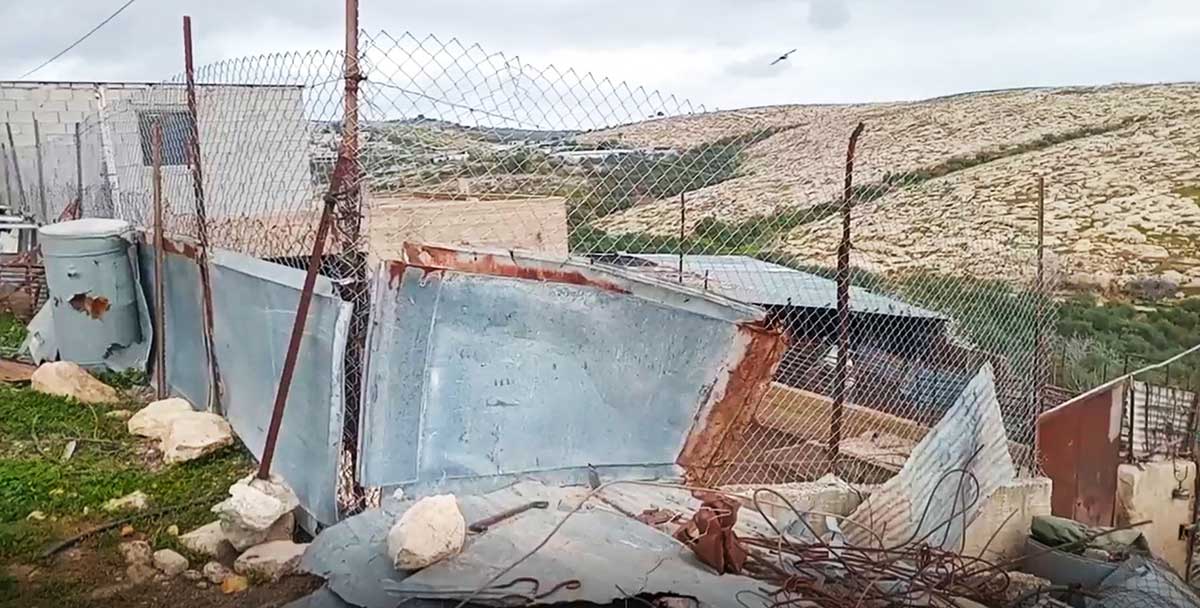
Several residents carried him down the hill and drove him in a car to a clinic in the neighborhood of a-Ram. Abu Siyam could not be taken to a hospital in Ramallah, as the DCO checkpoint, located at the eastern entrance to the city, was closed at the time. The clinic’s medical staff recommended taking him to hospital in Ramallah for urgent surgery, but since the military also closed the Jaba’ checkpoint, located at the southern entrance to Ramallah, and due to heavy traffic in the area, his friends had to carry him on foot for about a kilometer, up to the entrance to Qalandiya Refugee Camp, from where he was taken by ambulance to the hospital in Ramallah.
Due to the considerable delays, Abu Siyam did not arrive at the hospital until around 5:00 P.M., more than two hours after he was shot. He arrived in critical condition and with no pulse. The doctors initially managed to resuscitate him, but his condition later deteriorated, and at 11:00 P.M. that night, they pronounced him dead.
In the following days, the farm owners went to the Geva Binyamin police station at least four times to file a complaint against the settlers, but the police officers denied them entry to the station on various pretexts.
Attacks on Palestinians by settler militias, fully backed by the military and police and often with their active participation, were a daily feature of life in the West Bank before 7 October 2023, and have become more so since. The State of Israel arms these militias and provides them with off-road vehicles they use to attacks Palestinian communities and residents. In doing so, the state not only gives the settler militias free rein but actively encourages harm to Palestinians in the West Bank: daily harassment, theft and damage to property, as well as violence that often ends in injury or killing.
Israeli authorities are doing more than turning a blind eye. They are practicing a policy of absolute impunity for the attackers, which enables the violence to persist and fuels its escalation, making the lives of Palestinians in the West Bank unbearable and driving them off their land. The full item