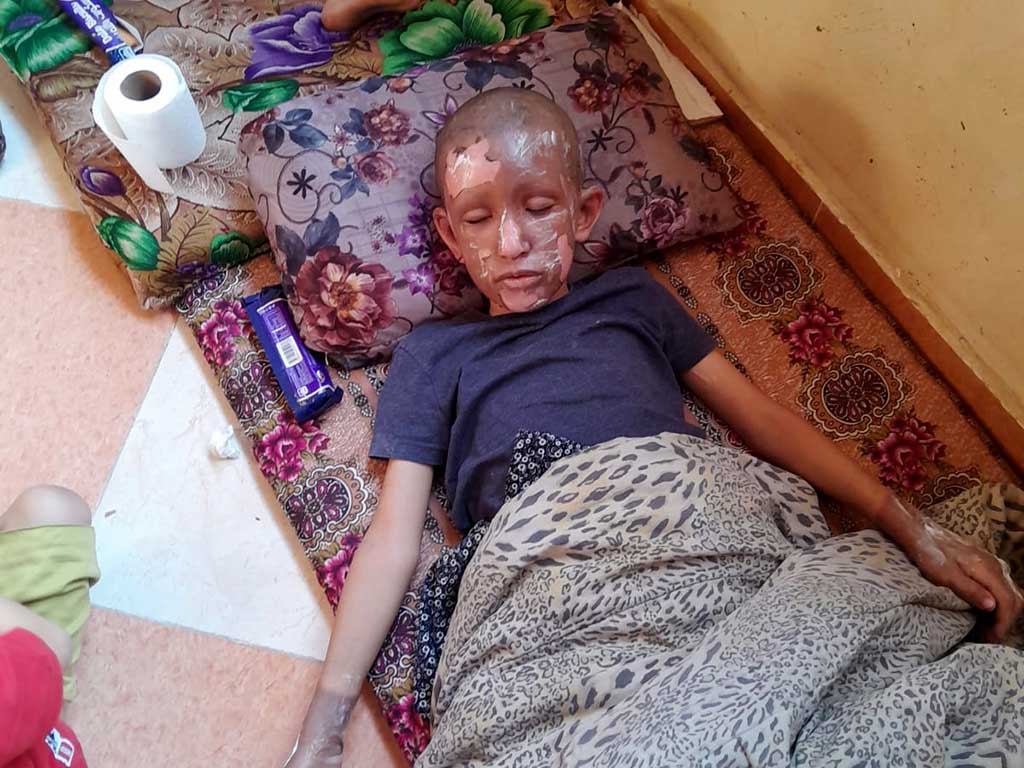
A 31-year-old father of four from a-Rimal neighborhood in Gaza City, Nidal spoke about the bombing in which he lost his wife and three of his children, and about his surviving son, who was severely burned:
I lived in an apartment on the fifth floor of a building on al-Yarmuk Street, in the a-Rimal neighborhood in Gaza City, with my wife, ‘Abir al-Halabi, 27, and our four children: Hani, 8, Muhammad, 5, Muhannad, 3, and Eileen, 20 months. Now, we’re in the IDP camp at the UNRWA training center in Khan Yunis.
I’m a nurse. For the first two days of the war, we stayed at home and I kept on working at the al-Wafa Hospital for the Elderly, but on 8 October 2023 there was already a bombing near our house. The windows in our apartment shattered, and glass shards flew on my wife and children. Before I even got home from work, my wife and children moved with my brother and his family to my parents’ house on al-Jalaa Street in Gaza City. I joined them when I finished work. We spent the night there. The next day, partly because heavy bombings started there too, we moved to my cousin’s house on a-Lababidi Street, but the bombings followed us there. The next day, we moved again to the home of other relatives, and two days later to the home of some other relatives.
On 11 October, we went to Khan Yunis. We went to the IDP camp at the UNRWA training center, but conditions there were terrible, and we went back to Gaza City after four days. We went to my wife’s parents’ apartment, on the second floor of a three-story building in the western part of a-Rimal neighborhood. We crowded together there with a lot of other people: my parents, my siblings and my wife’s family – about 18 people. The area was heavily bombed.
On 18 October, my father went out shopping and I took Hani to get some fries. When we came back, just as we reached the door to the apartment, there was a strong blast. I was holding Hani’s hand, but it didn’t help. The shockwave sent him flying into the fire that started up because of the blast, and I fell on the floor. I got up and started shouting and looking for him, but I couldn’t see anything because of the thick smoke. In the end, I found him and hugged him, and we managed to get outside. My wife and our other children, Muhammad, Muhannad and Eileen, were killed along with 26 other people.
We were in shock when we got outside. Hani was burnt in the face and hands. His face was black. I checked the rest of his body to see if he was hurt anywhere else. My mother, Widad al-Halabi, 53, was badly injured in the left arm. Her blood vessels were severed. I found a car that took us to a-Shifaa Hospital. When we got there, I left Hani with a nurse I know and went with my mother, who was in bad shape. Then I left my mother with my brother Salim, who also came to the hospital, and I went back to Hani, who was already admitted to the burn unit.
He was treated with an ointment to relieve the pain and prevent infection. We were discharged after an hour, but my mother stayed in hospital four more days because of her injuries, and also because she has high blood pressure and diabetes. After that, Hani panicked every time he heard planes and was sure they were going to bomb us again. His whole body shook. He kept saying he didn’t want to die and begged for us to go to Khan Yunis.
On Monday, 22 October, we did go south with other people from my family. We went back to the IDP camp at the training center in Khan Yunis. There are 12 people from our family here now, and we put up one tent for all of us. Because I’m a nurse, I can treat Hani’s burns with ointments, solutions and bandages. That’s all we have here. There are no real medical supplies.
He has second and third degree burns. He’s in pain and is in bad shape psychologically. He’s anxious and agitated, cries a lot and has nightmares. He also started bedwetting, which embarrasses him in front of the other children because he has to wear a diaper. He’s withdrawn, and a lot of the time just sit sand stares. I try talking to him and he doesn’t answer. The kids are scared of him because of the burns on his face, and he doesn’t go out to play with them. He doesn’t even want to leave the tent.
* Testimony given to B'Tselem field researcher Olfat al-Kurd on 7 January 2024