A 42-year-old mother of seven, Kifah spoke about her husband and son being injured in the first days of the assault on the Gaza Strip, the displacement from her home in the town of al-Mughraqa, the hunger, the horrific conditions in the displacement camps and the particular difficulties women currently face in displacement sites in Gaza:
Before the war, I lived with my husband, Ishaq, 42, and our seven children, Muhammad, 20, Hamzah, 19, Ruaa, 17, Muayad, 16, Samer, 13, As’ad, 12, and Dima, 5, in the town of al-Mughraqa, southwest of Gaza City, and I had a very simple life.
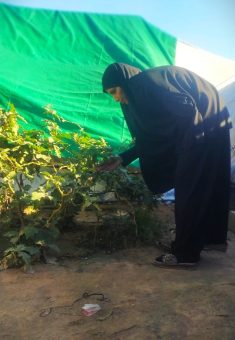
I would wake up in the morning, say the dawn prayer, then wake up the children and make them breakfast. After they went to school, I would sit and drink coffee while listening to Fairuz, then start on the housework. That was my daily ritual. I always started with the garden. I felt as if my garden was calling me from the morning. It had olive trees I had planted, basil, mint and several kinds of vegetables that I had planted. I also raised chickens, and I would feed them, water the garden, weed and do other garden work that made me very happy.
Then, I’d go back inside and start the daily housework. We had running water all day long. We got electricity regularly according to a schedule, and when there was electricity, I would bake bread. I had walls around me. I had a room of my own. I had clothes. I had a washing machine, and I would clean the house using all the equipment and cleaning supplies I needed. In the afternoon, the children would come back from school, and after they ate, I would help them with their homework. Then, I would make a pot of tea and popcorn, sit with them, and we would talk and spend time together. In the evening, my husband would come back from work, we would have dinner together and watch a TV show, and before going to sleep, we caught up on the news on social media.
My life was like a paradise, and since 7 October, I have been in hell. At first, we heard gunfire, and then my children came running home from school, and the power went out. My husband and I were very tense, and I feared the worst, but I could not imagine the nightmare our lives were about to become. Words cannot describe the fear and the hell we are living in.
Three days after the war started, on 10 October 2023, my husband went to visit his brothers, who lived about 200 meters away from us, with our son Muhammad. While I was saying the afternoon prayer, there was heavy bombing. Planes bombed several locations, creating a fire belt. It sounded and felt like an earthquake. I was so scared that I stopped praying. I saw people running toward the place that had been bombed, and I heard them saying that the al-Hasanat family’s house had been attacked. I told the children, “Your father has been attacked!” and ran over there with them, barefoot, in my prayer clothes.
What I saw when I got there looked like scenes from Judgment Day. A three-story building that had collapsed onto the ground, decades-old olive trees yanked out of place, dust everywhere. I went into shock and started screaming like a madwoman, “What happened?! What happened?! Who was killed and who was injured?!” When they started pulling the casualties out from under the rubble, I ran after them and asked, “Who died? Where is my husband? Where is my son? Where are my brothers-in-law?” but no one answered me.
Then I saw them pull my brothers-in-law out from under the rubble: Mar’i, 38, Mus’ab, 32, and Muhammad, 28, with his wife Aya, 17, who got married only about five months earlier, and my brother-in-law ‘Iz a-Din, 26. They were all killed. With every casualty they pulled out from under the rubble, my heart was crushed with pain. I married young and grew up alongside my brothers-in-law, my husband’s younger brothers, who had lost their father, and he had taken care of them since they were all little.
In the meantime, I found out that before I arrived, they had rescued my husband, who was injured, and evacuated him to hospital. He had a liver hemorrhage, tendons in his hands were cut, and he had wounds in various parts of his body. My son Muhammad was injured in his legs and my brother-in-law Mu’amin was lightly injured. I went back to my children, and I couldn’t go to the hospital that day, because I didn’t want to leave them alone at home. They cried bitterly for their uncles and for their father. Hamzah was with his father and brother at the hospital.
The next morning, our neighbors’ house was bombed, and everything was covered in dust. I called a taxi and took the children to Nuseirat Refugee Camp, because the situation in al-Mughraqa was very dangerous. Death was after us, and fear had taken over us. In Nuseirat, I left the children with relatives, and from there, I went to see my husband and son at Shuhadaa al-Aqsa Hospital in the city of Deir al-Balah.
When I arrived at the hospital, my husband was in intensive care. He asked me about his brothers, and I had to tell him that Mar’i, Mus’ab, Muhammad and his wife and ‘Iz a-Din had been killed. He was stunned. He asked me if they had been buried, and when I told him they had, he started shouting that he had not said goodbye to them and had not had time to see them one last time. It was heartbreaking and very painful.
From that point on, my life was turned upside down, and I found myself in a hellish cycle: My husband and son were injured in Deir al-Balah, and my son Hamzah was with them. The other children were in Nuseirat. There were bombings everywhere. My son Muhammad was traumatized in a bombing in his childhood, and since then, he hasn’t spoken and has suffered from mental health issues. During his hospitalization, he started wetting himself. I traveled to the hospital and back to the children every day. Transportation was very difficult, and I didn’t always have a way to get there. The bombings never stopped, and my children were even more afraid than before. The younger ones also started wetting themselves.
At that point, we had to leave our relatives’ home, and we moved to a school that was turned into a displacement camp in a-Nuseirat Camp. We had nothing, not even a change of clothes. Relatives donated a few blankets and mattresses, and all of us, me and the five children who were with me, slept huddled together on the mattresses in a classroom that was full of displaced people. More than anything, I was preoccupied with how to get food for my children and for my husband and two sons who were in hospital. I would wait every day for the aid we got at the school, but it wasn’t enough.
I was exhausted from running back and forth between the hospital and the school, and I started visiting the hospital less. When people asked me how my husband and my son Muhammad were doing, I cried and couldn’t give an answer. I had no strength left. I also had to stand for hours in line for the bathrooms and for water, and I started suffering from bleeding and severe weakness. I would wake up at dawn, just to stand in line to fill a small container of water.
One day, I came back exhausted from a visit to the hospital. When I sat down, one of the women in the displacement camp said to me, “There’s blood all over the chair!” My daughter and another displaced woman immediately walked me to al-‘Awda Hospital in a-Nuseirat Camp. They ran blood tests and found out that my hemoglobin level was 5. The doctor told me that my life was in danger, that I had to undergo surgery to stop the bleeding, and they urgently sent an ambulance to bring blood units from Shuhadaa al-Aqsa Hospital. They gave me blood units, and the doctor said that if the bleeding did not stop, they would have to remove my uterus, and that’s what happened. I had the surgery the next day and was discharged from the hospital the same day because it was so crowded there. After the surgery, the bleeding continued, and I looked everywhere for pieces of cloth to use instead of pads.
I went back to the displacement camp on a donkey-drawn cart, because I couldn’t find any other transportation. When I arrived, I found my children hungry, so I went around among the displaced people and asked them to lend me bread. That was the most painful thing of all, that I had no food for my children.
The situation in the displacement camp was horrific, and the overcrowding was terrible. The children suffered greatly from this situation, and those were very painful days, especially for us women. My condition made the difficulties involved in using the bathroom even worse. I needed to go to the toilet a lot, and I’m embarrassed every time because the whole world sees and knows you’re on your way to the toilet. I swear to God, there was a time when we couldn’t shower there and didn’t change clothes. I couldn’t believe I would sink so low, but I clung to life. After two months, my husband was discharged from hospital and joined us in the displacement camp. About two months after him, my son Muhammad was discharged from hospital, and he slept with his father, like all the men, in the schoolyard. We women and the children slept upstairs in the classrooms. I would go down to him in the morning to see how he was, change his clothes, and take him to the bathroom.
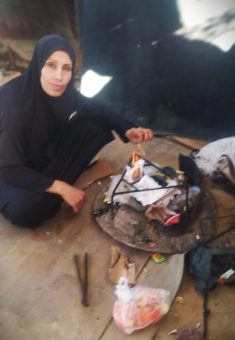
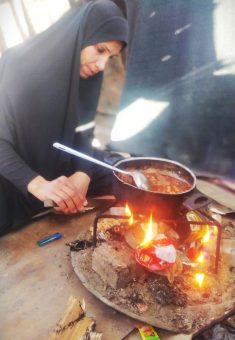
At that time, the hunger grew worse. The markets ran out of goods, and my husband needed healthy food in order to recover. There was no gas for cooking. I walked around with my sons, and we collected old shoes and plastic items to light a fire and make a bit of food. Because of the fire and smoke, I started suffering from severe chest pain, at an unbearable level, and it has continued to this day.
Flour ran out then, too. When I did manage to get flour, I would bake a very small amount of bread for the children and divide it equally among them. My children cried from hunger. Only some of the displaced people received aid, and it angered me that the distribution was unfair. There were also people who stole some of the aid, which wasn’t enough to begin with. I longed for a cup of sweet tea, to sit and drink it with the children and with my husband. We were so hungry that our breath smelled. My children would say, “We’re hungry,” and my husband would look at us and cry.
I had no choice. I told myself, “Even if I die, I have to go back home to bring flour and clothes.” I had a watch. I gave it to my daughter Ruaa and told her: “Wear the watch. If I die, you’ll have it as a keepsake from me.” I went to our house in al-Mughraqa with my son Muayad. They fired live bullets at us like rain. Muayad said to me, “Mom, let’s go back, it is too dangerous.” But I insisted on going. When I arrived home, I found some clothes, a bag of salt, some rice. I was happy that I had found a bit of food and shoes for my children. There are no words to describe how happy my children were when they put their shoes on.
After that, the Israeli military ordered a-Nuseirat to be evacuated. I cried and hugged my children. We had nowhere to go, and I had no money to pay for transportation to Rafah. We climbed into an animal-drawn cart and reached the city of Deir al-Balah. I didn’t have money to buy my own tent, so we put up a tent with several of my husband’s relatives, but it was too small and barely held everyone. That is how I lost my privacy as well. Everyone’s children kept fighting among themselves, and problems also arose between me and my husband’s relatives over the simplest things.
The bathrooms were very far away, and my daughter and I had to walk half an hour on foot to reach them. I started holding it in, just to avoid going to the toilets, and that caused me problems passing urine. My daughter and I also suffered from a lack of sanitary pads, which had run out in the markets. I couldn’t even find clothes to cut into pieces of cloth to use instead of pads.
It was very cold inside the tent, and in winter, when it rained, it flooded and our clothes and blankets got wet. Our legs turned blue, and the skin on our hands cracked from the cold. My young children couldn’t control their urination because of the bitter cold.
After a while, we improvised our own toilet next to the tent. It was a primitive toilet, but I felt as if I had gotten a mansion, compared to the suffering of the distant bathrooms we shared with the other displaced people.
Later, aid distribution points were opened. Those were some of the hardest days we went through. My son Hamzah would go to get aid, although I forbade him to go there for fear for his life. But he insisted, telling me: “I’m dead anyway! We are hungry. We want to eat.” He would go at night to Netzarim, risking his life to bring us some flour and canned food, and I would sit in my prayer clothes and pray, imagining them coming to tell me that he had been killed. When he came back safely, I would smother him with hugs and kisses.
Every time I heard about a massacre in Netzarim, I would get dressed and go out into the street to ask the young men who had returned from the aid points about Hamzah, or go to look for him among the fatalities in the hospitals. My nephew, ‘Ammar al-Hussni, 24, was killed at the aid point in Netzarim. A week later, his paternal uncle, Mu’tasem al-Hussni, 38, was killed in Zikim, leaving behind orphans, young children. Ten days after him, my sister Bisan’s husband, 27, was killed in Zikim, and his body was not found. Bisan went to look for him herself and found that dogs had devoured his body and dragged it away. She identified him by his shoes. She called an ambulance that evacuated the remains of the body to a-Shifaa Hospital.
I do not know how we got through the period of severe hunger. I was skin and bones. I could barely stand on my feet, and I don’t understand how the world just watched us dying of hunger! Before the war, I weighed 85 kilograms, and now I weigh only about 55.
After that, we went back to a-Nuseirat Camp, to be close to our town, al-Mughraqa. We’ve been here ever since, living in a tent, and we are still going through endless suffering. I light a fire first thing in the morning, collect papers and bits of wood with my children to feed it and prepare food, and wait in line at the Takia [charity kitchen]. We split into several queues there in order to get a tiny amount of food. To get one container of drinking water, we wait for hours for the water trucks under the blazing sun and in the bitter cold. Sometimes we wait and end up getting nothing, because there are so many displaced people trying to get some food and water.
One time, when my daughter Ruaa was waiting for food and the food ran out by the time it was her turn, she burst into tears. The person in charge there asked her, “Why are you crying?” and she told him: “Because I didn’t manage to get food,” so he gave her from the food he had set aside for his family. When Ruaa told me this, I cried a lot. To this day, I cry when I remember this story. I was always embarrassed standing in line for the water truck and at the charity kitchen, and my children turned out like me. The heart aches.
I forbade my son Hamzah to stand in line for bread at the bakery, because fights kept breaking out there, and I preferred to stand in line myself. I would go out at 2:00 A.M. to stand in line for bread with other women, even though distribution only started at 6:00 A.M. By the time I finally got the package of bread, I was suffocating in the crush. One day, when there were crowds of displaced people there, with pushing and shoving, I felt that a young man was waiting to snatch my bread package. I hugged the package tightly and, with great effort, pushed myself out of the crowd. I came out choking, and without my headscarf. It was a very hard day for me. I felt like I was about to die. It’s so cruel, but I had no choice but to provide for my children’s needs.
Today, I call Gaza “the city of sorrow”. I wish for death because it’s very hard to live in Gaza. I swear that once, during the starvation period, I prayed to God that my children and I would be killed already. It’s better than living with this humiliation.
I’ve been doing the laundry by hand since the war began, and it wears me out and exhausts me. My hands hurt, and sometimes I can’t even take off my own clothes because I can’t lift my arms, and my daughter Ruaa has to help me. Cooking over the fire has also damaged my health and caused me respiratory and vision problems. Anyone who sees me thinks I am an old woman, although I am only 42. All my hair has turned white from extreme anxiety and psychological stress. My hearing has also been damaged by all the enormous explosions that were heard throughout the war. I can only hear if it’s very close to me.
In addition, since we started living in tents, we’ve all caught scabies and lice. We wash without soap because there is no soap for washing. My children suffered from rashes and pimples that left scars on their bodies. The tent is made of fabric, and there is no privacy in it. My daughter and I can only change when everyone is out of it, and we spend all day in our prayer clothes, which are outer garments. The tent is also infested with ants, and we suffer from their bites and from other insects. I go to sleep in my prayer clothes, too, and they’ve started to tear. I feel ugly and unkempt. Even the shoes I wear don’t match, because I have no other shoes.
There is almost no marital relationship between my husband and me, not even an affectionate relationship. Since the beginning of the war, we haven’t said one kind word to each other. This war and living in a tent have consumed everything good in my life. Now I am homeless, wandering, moving from tent to tent and from street to street, running from charity kitchen to charity kitchen and from line to line. How long will this pain we carry go on? How long will we live like this?
* Testimony given to B’Tselem field researcher Olfat al-Kurd on 4 February 2026
Read more: Clinging to what’s left of life: Palestinian women under genocide in Gaza, 8 March 2026