A 28-year-old from a-Nuseirat R.C. in the central Gaza Strip, Basel described the daily struggle to feed his family and risking his life at aid distribution centers
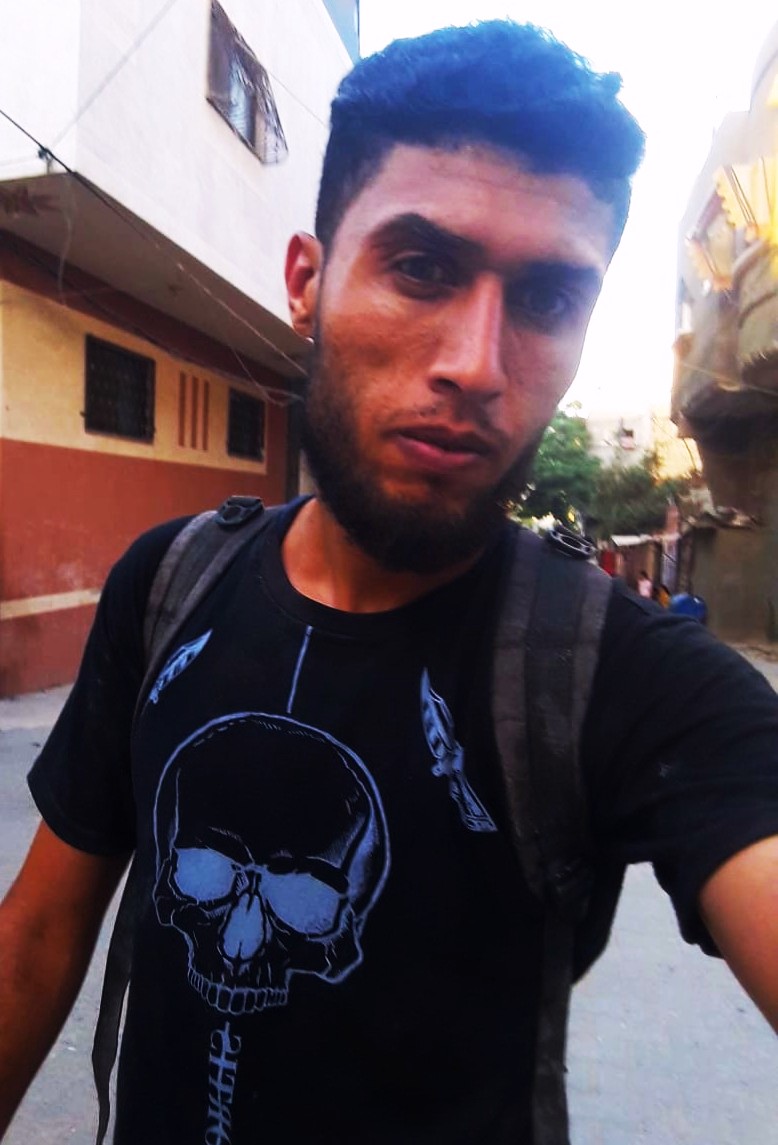
I live with my parents, brother and two sisters. I’m the only breadwinner in our family. For about three months now, we’ve been struggling to get food. It’s especially hard to get flour, which is a basic staple for us. Meat or poultry are out of the question.
Before the war, I had a falafel stand in the a-Nuseirat camp market. But because of the lack of oil and cooking gas, and the high price of basic ingredients like legumes, I had to stop making falafel. Instead, I started selling cleaning products, and sometimes I buy and sell small amounts of food depending on what I can get in the market. That allows me to buy groceries for the family. Because the prices have skyrocketed, I find myself sometimes buying a liter of oil for 180 shekels [~53 USD], or a kilo of tomatoes for 60 shekels [~18 USD]. A kilo of cucumbers costs the same. We haven’t eaten meat or poultry in a really long time.
For cooking, we’ve used wood because there’s no gas. A kilo of firewood costs 8 shekels, but it’s not enough for cooking or heating water to wash. We usually buy 3-4 kilos for 20-30 shekels.
Since they stopped allowing aid into Gaza in March 2025, when the ceasefire ended, flour has almost disappeared from the market. When it’s available, a kilo can cost up to 90 shekels [~27 USD]. To save on flour, my mother ground pasta or lentils and made pita bread out of them, even though a kilo of lentils costs 40 shekels. It tasted horrible, but we had no choice. We eat whatever there is.
About a month and a half ago, they announced the establishment of aid distribution centers. At first, I was scared to go. The centers are far away from my house, and I heard people were being shot there, injured and killed. My family also didn’t allow me to go, out of fear I’d be hurt.
But when the situation got even worse, I had to try and get food for my family, especially after I closed my stand in the market. I decided to go to the distribution center in Netzarim. I walked four kilometers each way. I thought the distribution would be organized, so I brought my ID with me. But when I got there, I found thousands of people waiting without any order.
They only allowed us into the yard where the aid is distributed around 4:00 A.M. It was total chaos. The weak don’t survive. We walked between dirt embankments and narrow passages, pushing in and climbing to get to the yard. Meanwhile, the army fired heavily at us. A lot of people were injured but no one could get them out because everyone was scared they’d be injured or run over. After a lot of suffering, I finally got into the yard, only to find there was nothing there. They don’t bring enough food packages for everyone who shows up.
I went home empty-handed.
The same thing happened when I went back to Netzarim on another night. There was heavy shooting there, too, and a lot of people were injured and killed. We follow the military’s announcements about distribution times online, but they don’t follow through on the hours they publish. Sometimes they say it’ll start at 6:00 A.M., but they actually open the gate at 2:00 or 4:00 A.M. So people go the night before and thousands of people wait there.
There’s no organized system for getting in. People take risks and go towards the entrance because whoever gets in first has a higher chance of getting the aid. Sometimes the army allows us to get close and then starts shooting. Every time, people are wounded and killed.
I kept going there every two or three days. One time, when I got there, I found food that had fallen from open boxes and gathered it – several kilos of flour, a package of salt, cooking oil, canned beans and peas. I put them in a bag I brought with me and went home.
One night, I went there and waited as usual. I started advancing together with other people because we thought it was allowed, and then everyone started running together. Suddenly, there was a barrage of heavy fire from tanks stationed a few hundred meters from us and from drones. I lay down on the ground behind a dirt embankment, crawled and got away. That night, more than 30 people were killed and about 50 were injured.
When I come home empty-handed, I feel really bad. I’ve made a huge effort. I’ve walked kilometers, crawled, run, pushed in among thousands of people, all while risking my life. And in the end, I come back with nothing.
One time, I was on my way home from Netzarim with a few boxes of food when one of the thugs tried to take the bag of food from me. I refused, and he stabbed me in my right hand with something sharp. He ran away, and I continued on home. I was so exhausted I didn’t even realize I’d been hurt. When I got home, I saw my clothes were soaked in blood. I went to al-Awda Hospital, where they cleaned and dressed the wound.
The distribution center is very far from my home. The road isn’t paved, and at night we walk between the rubble of buildings. We’re constantly shot at, and there are thugs and thieves everywhere. There’s danger all around us. If I get hurt, there will be no one to help me – especially at the aid distribution centers, which are crowded and have no ambulances nearby. We’re never safe anymore.
Every time I leave for a distribution center, I see on my family’s faces how scared they are, as if it’s the last time they’ll ever see me. Going to an aid center feels like walking to my death. When I come home, it feels like God has given me my life back.
* Testimony given to B’Tselem field researcher Khaled al-'Azayzeh on 1 July 2025