Publications
Filter publications:
The pogroms are working - the transfer is already happening
For decades, Israel has employed a slew of measures designed to make life in dozens of Palestinian communities throughout the West Bank miserable. This is part of an attempt to force residents of these communities to uproot themselves, seemingly of their own accord. Once that is achieved, the state can realize its goal of taking over the land. To advance this objective, Israel forbids members of these communities from building homes, agricultural structures or public buildings. It does not allow them to connect to the water and power grids or build roads, and when they do, as they have no other choice, Israel threatens demolition, often delivering on these threats...
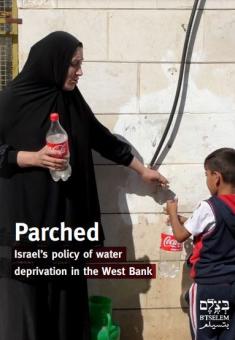
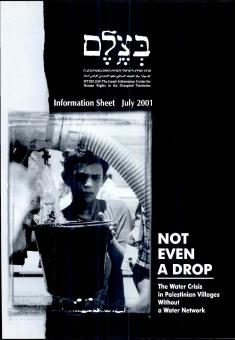
Parched
Israel’s policy of water deprivation in the West Bank
Average Israeli daily water consumption is 247 per person – three times the amount used by Palestinians in the West Bank, which is 82.4. Only 36% of the latter have daily running water. The shortage is not a force majeure but an outcome of Israel’s policy since the Interim Agreement, which treats water as another aspect of the mechanism controlling Palestinians. Israel has become a water superpower that no longer depends on natural sources, yet continues to deprive the rapidly growing Palestinian population of water.

Expel and Exploit
The Israeli Practice of Taking over Rural Palestinian Land
The report B’Tselem published today shows how Israel has been taking over Palestinian rural space, fragmenting it, dispossessing its residents of land and water, and handing over these areas to settlers. The process is illustrated through a case study of three villages in the Nablus District - ‘Azmut, Deir al-Hatab and Salem - telling what these communities have undergone since Israel established the Elon Moreh settlement nearby. Through this case study, the report illustrates a broader policy Israel has been implementing throughout the West Bank for decades, and in which the settlers play a key role.

Acting the Landlord
Israel's Policy in Area C, the West Bank
60% of the West Bank is designated Area C, under exclusive Israeli control. It is home to 180,000 Palestinians and includes most West Bank land reserves. Israel, citing “state lands” or “firing zones”, largely prohibits Palestinian construction. Israel’s planning policy ignores local needs: refuses to recognize villages or draft plans; blocks development and infrastructure hook-ups; and demolishes homes. Thousands are in danger of expulsion for living in firing zones or “illegal” communities. Israel has appropriated most water sources and restricts Palestinian access to them.

Human Rights in the Occupied Territories
B'Tselem 2011 annual report
The report surveys the broad spectrum of issues regarding the Israeli authorities' human rights record in the West Bank and Gaza Strip over the past year, the 44th year of the Israeli occupation. An interactive version of the report is available online and distributed through social media. The report documents a sharp increase in the number of uninvolved Palestinians killed by the Israeli security forces in the Gaza Strip in 2011. There was also an increase in the number of Israeli civilians killed by Palestinians, compared to 2010.
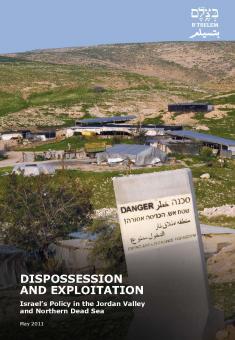
Dispossession and Exploitation
Israel's Policy in the Jordan Valley and Northern Dead Sea
Israel exploits the natural resources in the Jordan Valley more than in the rest of the West Bank and prevents Palestinians from using most of the area's land and water resources.
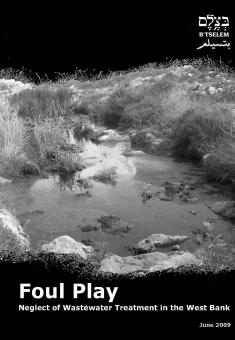
Foul Play
Neglect of wastewater treatment in the West Bank
The report warns about the danger inherent in neglecting wastewater treatment in the West Bank. The report criticizes both Israel and the Palestinian Authority for their failures, which have harmed the health and future water supply of all residents of Israel and the West Bank.
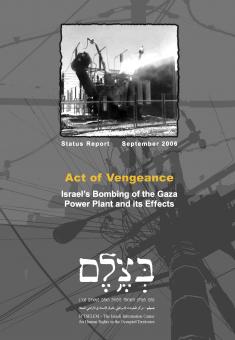
Act of Vengeance
Israel's Bombing of the Gaza Power Plant and its Effects
The report shows that most residents of the Gaza Strip continue to be cut off from electricity half of every day, with wide-ranging, adverse affects.
Cooperating Against Justice
Human Rights Violations by Israel and the Palestinian National Authority Following the Murders in Wadi Qelt
Israel’s regime of apartheid and occupation is inextricably bound up in human rights violations. B’Tselem strives to end this regime, as that is the only way forward to a future in which human rights, democracy, liberty and equality are ensured to all people, both Palestinian and Israeli, living between the Jordan River and the Mediterranean Sea.
Since the Hamas attack on 7 October 2023, Israel has acted in a coordinated and deliberate manner to destroy Palestinian society in the Gaza Strip, committing genocide against its residents. In light of Israel’s actions in Gaza, the public statements made by Israeli decision-makers, and the international community’s failure to take effective action, there is a serious risk that the Israeli regime will expand the genocide to other areas under its control—first and foremost, the West Bank.
B’Tselem calls on the Israeli public and the international community to use every tool available under international law to bring an immediate end to Israel’s genocide against the Palestinian people.