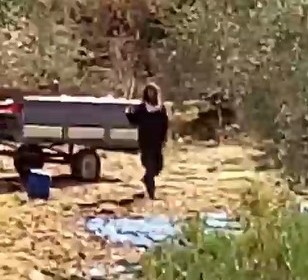
On Saturday, 1 November 2025, at around 7:00 A.M., Damur a-Ziben, a 58-year-old farmer from the village of al-Mazra’ah a-Sharqiyah, went to his olive grove, located about 800 meters west of the town, near Route 60. He had come to the grove with a tractor and trailer, and five laborers he had hired to help with the harvest.
At around 10:30 A.M., a car stopped on Route 60 nearby, and seven settlers got out of it. A-Ziben and the laborers fled the area and watched from a distance of about 50 meters as the settlers began loading his agricultural equipment onto his trailer. A-Ziben tried to document the incident, but after he saw that one of the settlers had noticed him, he and the laborers left the area and went back to the village for fear of being attacked.
The next day, a-Ziben returned to the same spot and discovered that the tractor, trailer, agricultural equipment and harvested olives had been stolen.
In a testimony he gave B’Tselem field researcher Mohammad Romaneh on 3 November 2025, Damur a-Ziben, 58, a father of five, stated:
I am married and have five sons, aged 19 to 34, and I live in the Wadi a-Sanah area at the entrance to the town of al-Mazra’ah a-Sharqiyah.
My siblings and I have land measuring about 15 dunam (1 dunam = 0.1 hectares) in the Wadi al-Baqarah area, west of the town, near Route 60. Our plots are scattered on both sides of the road and lie in an area that was defined in the Oslo Accords as Area C.
In the past, I used to go to this land without needing coordination or a permit, and during the plowing and harvest seasons, I’d go there on an almost daily basis. But in 2023, occupation soldiers denied us access to the area, claiming it was too close to Route 60. In 2024, settlers came to harass us during the harvest, and then soldiers drove us away.
On Saturday, 1 November 2025, at around 7:00 A.M., I went there with five laborers I had hired to help me with the harvest. We drove a tractor with a trailer, where I had put the equipment.
I parked the tractor among the olive trees, and the laborers began preparing everything for the harvest, and then we started picking the olives. We worked in a plot of seven to eight dunam west of Route 60. There were no soldiers or settlers there.At around 10:40 A.M., as I was sitting under an olive tree drinking coffee, about 20 to 25 meters from the tractor and the laborers, one of the laborers came up to me and said that a settlers’ car had stopped on Route 60 opposite us. I got up to look out at the road and see what was happening.
The moment I saw the settlers approaching, I shouted to the laborers to get back and started running because I was afraid the settlers would attack me. I backed away about 50 meters, then stopped behind a large tree and filmed the settlers on my phone as they reached the spot where the laborers had been picking, next to my tractor. I saw one settler take the electric olive shaker out of the tractor trailer. When the settlers saw that we weren’t coming back, they started loading all the equipment that had been on the ground onto the trailer.
Then I saw that the settlers had noticed me and were updating each other about my presence, so I put the phone in my pocket and backed away from there. The next day, I passed by the grove on the road and discovered that my tractor and trailer were no longer there.