Wadi Qatunyah, located in the al-Khalayel area on land belonging to the village of al-Mughayir, is home to three closely related families. Rizeq Abu Na’im, 69, and his wife live in a compound that includes a cave and several tents, together with their son Hamam, 36, his wife and their children. The family owns the land. Another son, Ayham, 35, lived with his wife and five children about 200 meters away, in two residential tents.
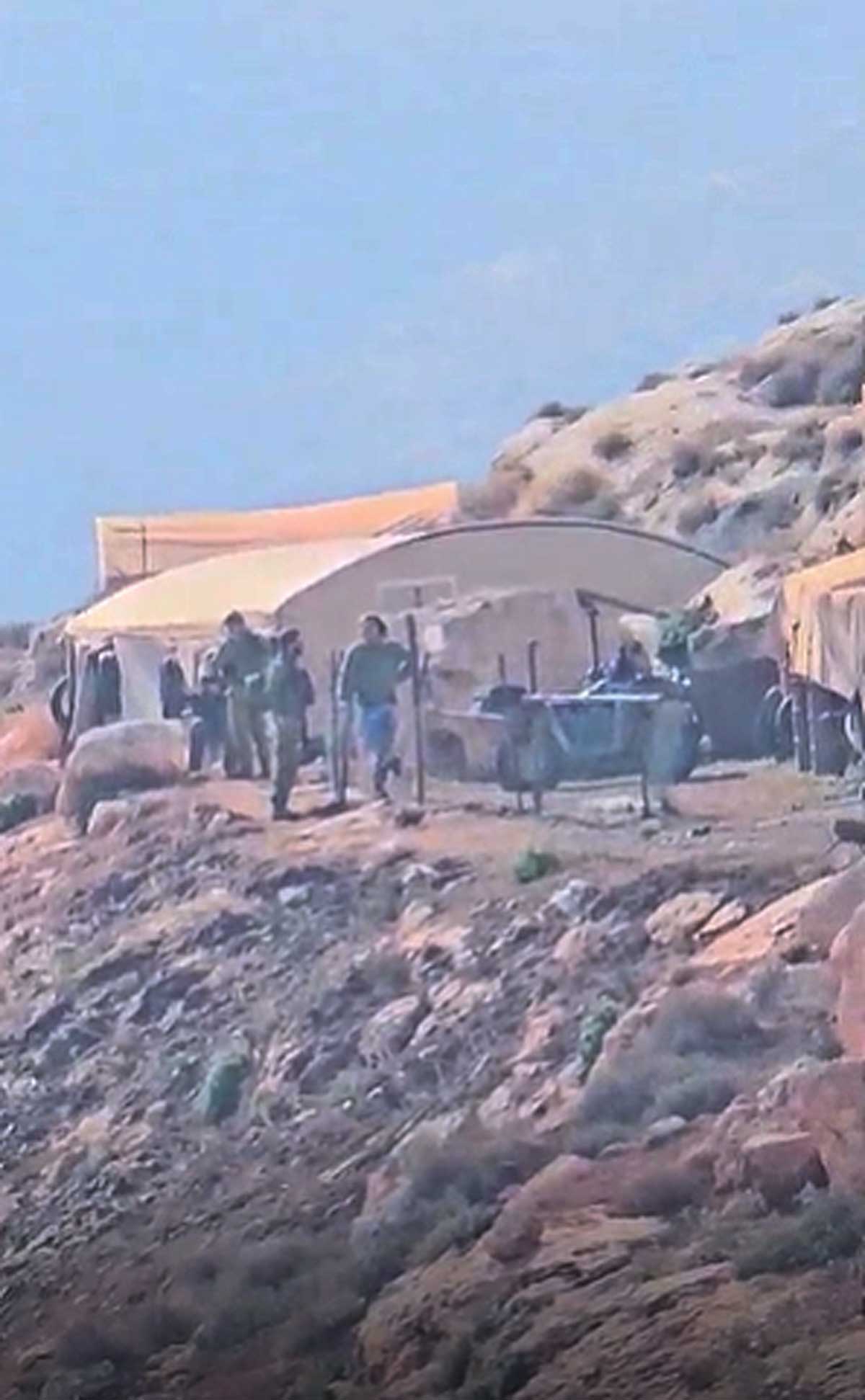
In July 2024, after learning that settlers had stolen a flock of sheep from a Bedouin family nearby, the extended family decided to move their own sheep to a site located approximately 200–250 meters north of Hamam and Rizeq’s tents.
On Sunday, 29 December 2024, around 7:00 A.M., two settlers arrived on ATVs at Ayham Abu Na’im’s compound from the direction of an outpost established in April, about 800 meters away. The settlers brought a flock of sheep with them. Ayham was away at the time, tending to the family’s relocated sheep, and asked his brother to go to the compound when he learned of the settlers’ arrival. Upon arrival, the brother discovered that the settlers had stolen four batteries and an inverter from the solar system that supplies electricity to the family. When he demanded they return the stolen items, the settlers ordered him to leave the area.
One of the settlers then drove toward the outpost on an ATV and returned several minutes later with a soldier. He then went back and returned with two more soldiers. Meanwhile, Ayham arrived at the camp. The soldiers blocked his access to the tents, ordered him and his brother to sit on the ground, and checked their IDs. The soldiers then ordered them, along with their cousins who had arrived in the meantime, to leave the area and head to the family’s cave.
The family members retreated to the cave and waited for the soldiers and settlers to leave. After about an hour, when they were still present, the family members returned to the tents to collect their belongings. The soldiers did not allow them to take anything and ordered them to leave and stay away. The soldiers and settlers left after about an hour and a half.
Around 3:00 P.M., after two Palestinian activists who had heard about the incident arrived at the scene, they went to the tent compound with about 13 cousins and other relatives of the brothers and began collecting belongings.
Within about 20 minutes, three masked soldiers and the two settlers who had stolen the equipment earlier that morning turned up. The soldiers went to the cave, where Ayham and Hamam Bani Na’im were sitting with their cousins. They called one of the cousins over and tried to speak to him in broken Arabic. When he did not understand, the soldiers called someone who spoke Arabic to tell him that the family and their relatives must leave the area and keep away. One of the soldiers then threatened to shoot the family members if they returned. The soldiers pushed the Palestinians and swore at them before leaving.
Following the attack and threats, Ayham Bani Na’im and his wife, who was pregnant at the time, moved their tents closer to the village of al-Mughayir and farther from the outpost. They have not returned to live at the original site since.
Ayham Abu Na’im, 35, a father of five, spoke about what happened when the family returned to collect their belongings in a testimony he gave B’Tselem field researcher Mohammad Romaneh:
Three soldiers showed up, each dressed differently, all of them masked. None of them wore a military helmet. The two settlers who stole the batteries and the inverter also came with them. The two settlers stayed near my tents, and the soldiers came toward our cave.
When they came within five meters of where we were sitting near our cave, they called out in Arabic to my cousin. One of the soldiers spoke to him in Hebrew, which he doesn’t understand very well, so he didn’t understand what the soldier said. The soldier called someone, then handed his phone to my cousin and put it on speaker. There was an Arabic-speaking man on the line who asked my cousin why we returned to the place after the army told us we were not allowed to be there, and why we lit a fire near my tents.
My cousin replied that we checked with the Palestinian DCO, and they told us there was no military order prohibiting us from being there, so we went back to our tents to get the children’s clothes.
The man on the phone asked why we lit a fire, and my cousin said we were burning trash. Then the soldier said to my cousin in broken Arabic, “Deir Balek [watch out], I will shoot you.”
Then the man on the phone told my cousin that the soldier would draw boundaries for us that we were not allowed to cross, and that the soldiers would shoot anyone who crossed those boundaries.
My cousin started telling him what these two settlers do there every day, but the soldier covered his mouth with his hand, pushed him, ordered him to be quiet, took the phone from him and hung up.
My mother screamed and then one of the soldiers told her, “Shut up, you daughter of a whore.” Then my cousin said to the soldier, “Why did you swear at her?”, and the soldier said to my cousin, “Shut up,” and then they left.