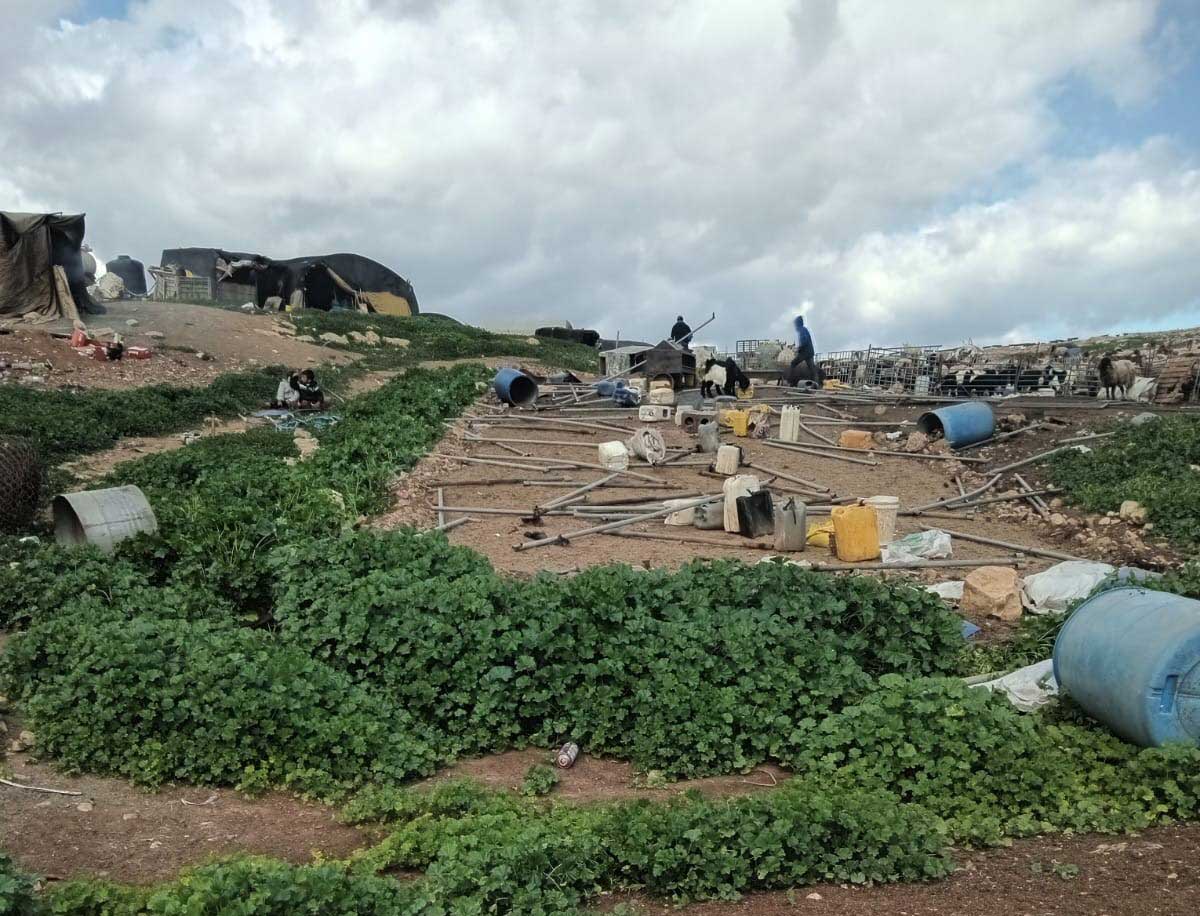
In the early morning hours of Wednesday, 26 February 2025, settlers set up an outpost just 50 meters from the homes of the extended Abu ‘Aram family in Khirbet Samrah, in the northern Jordan Valley. Originally from the Yatta area, the shepherding community relocated to the northern Jordan Valley about 10 years ago due to a shortage of pastureland. The extended family has 33 members, including the patriarch, Yasser, 59, and his 11 sons, three of whom are married and have children of their own.
After years of suffering settler harassment that included denied access to pasturelands, damage to farm fields and crops, and provocations within the residential compound, the family began the process of relocating the day after the outpost was established. They dismantled and packed up their tents and other belongings, and moved their livestock, on foot, to their new site east of Tubas.
After the family’s departure, the settlers abandoned the outpost they had set up in order to drive them out.
In a testimony given to B’Tselem field researcher ‘Aref Daraghmeh, Muhammad Abu ‘Aram, 34, a resident of Khirbet Samrah, said:
We lived in a hilly area far from people’s sight. We chose it years ago because it was suitable for habitation and grazing, and we leased the land from residents of Tubas.
We haven’t had a single night of sound sleep for months. Settlers would roam around our tents at night, and in the mornings, when we tried to find a safe place to graze the animals, settlers would sneak up on us on ATVs, with their cattle and sheep. They’ve spread out everywhere, harassing us, driving us off pastureland, and sometimes attacking us.
They have the support of the police and the military, who always believe them. If we try to talk to the settlers, they call the army, and they come and detain us for hours, saying we attacked the settlers, even though we never touched anyone.
On Wednesday, 26 February 2025, the settlers came near our tents, and we felt they were about to attack us. Then, what we feared happened: they brought tents and set them up just east of ours. They started shouting and threatening us so we would leave.
That was when my father and I decided to leave. We told each other we’d save ourselves. The settlers are dangerous and cannot be trusted. They’ve killed many people, and no one can stop them. We had to move away for our safety, despite the pain and bitterness it caused.
We started taking down the tents and brought more than three trucks to move our belongings. We had over 20 tents in Khirbet Samrah and a lot of other belongings. The move took more than two days. We moved to an area east of Tubas, where we managed to lease land. Every tent we took down felt like a small death and filled us with bitterness. We had grown used to life in this area, and moving wasn’t easy, for the women and children too.
This was a low point in our lives. But we keep hearing about settler attacks and their acts of violence, killings, and livestock theft. The settlers are cruel. They’ve blocked our access to the whole area. We were afraid they would attack us.
After we left, we came back to see what was happening at the site and found only empty tents left behind by the settlers. They had already gone. They came just to drive us out and empty the area of people.
Thank God we got out safe and sound, but we are afraid they’ll come after us at the new site too. No one does anything about the settlers’ attacks, and since the war, they’ve grown more ruthless. All the institutions of the occupation support them, and no one stops them. The occupation forces have demolished lots of homes in the area we moved to, so we’re afraid of them too.