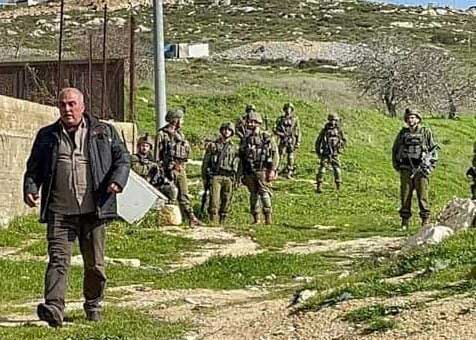
On 26 March 2022, at around 3:00 P.M., dozens of settlers accompanied by about ten soldiers arrived at the southern edge of the village and attacked homes and a parked car with stones. Other soldiers who arrived at the scene fired tear gas canisters and threw stun grenades at locals who came out to defend their property. Soldiers attacked the head of the village council, Hafez Saleh (57), who arrived at the scene to document the incident and report to the Palestinian DCO, knocking him down. They then handcuffed him, took him to a jeep and detained him for some twenty minutes, during which they swore at him and threatened to arrest him and let the settlers torch the homes.
In a testimony he gave B’Tselem field researcher Salma a-Deb’I on 26 March 2022, Saleh said:
I arrived after I was told about the attack on the phone to document what was going on and forward the documentation to the Palestinian DCO. When I got there, there were two groups of settlers, one of about 20 and the other of about 40-50. They were attacking my brother’s house and another house with stones. There were also about 12 soldiers there, standing in two groups, doing nothing. After about 15 minutes, about 50 more soldiers came, some of them in two military jeeps and some of them on foot. As soon as they arrived, they started firing tear gas canisters and throwing stun grenades in the direction of the local residents and the homes, even though the settlers had backed away by then, and things had calmed down. I stood near one of the homes with a few other adults from the village, filming on my cell phone. More than ten soldiers approached me and started pulling me forcefully, until they knocked me down. I told them again and again in Arabic and Hebrew that I was the head of the council and that I hadn’t done anything. The soldiers tied my hands behind my back with zip ties and walked me a distance of about 200 meters. I had a hard time walking because I have an issue with my leg, and I fell face down on the way. The soldiers picked me up forcefully and made me walk to the jeep, then had me sit on its seat and closed the door. They opened the door every few minutes, swearing at me, accusing me of stone-throwing even though I tried to explain to them that I’m the head of the council and that I didn’t do anything. They threatened to let the settlers burn our homes. This went on for about twenty minutes, and then one of the soldiers took me out of the jeep and led me back to the village homes. There was a soldier standing near the homes who said he was an officer and he was responsible for keeping both the settlers and the local residents in the area safe. I told him it wasn’t true, and that they only protected the settlers. The officer apologized for the soldiers attacking me. I started walking away from there with my hands still tied, and then the officer yelled to a soldier to take them off. On the way, I met my brother and went into his house to have a drink of water. My leg and whole body were hurting.