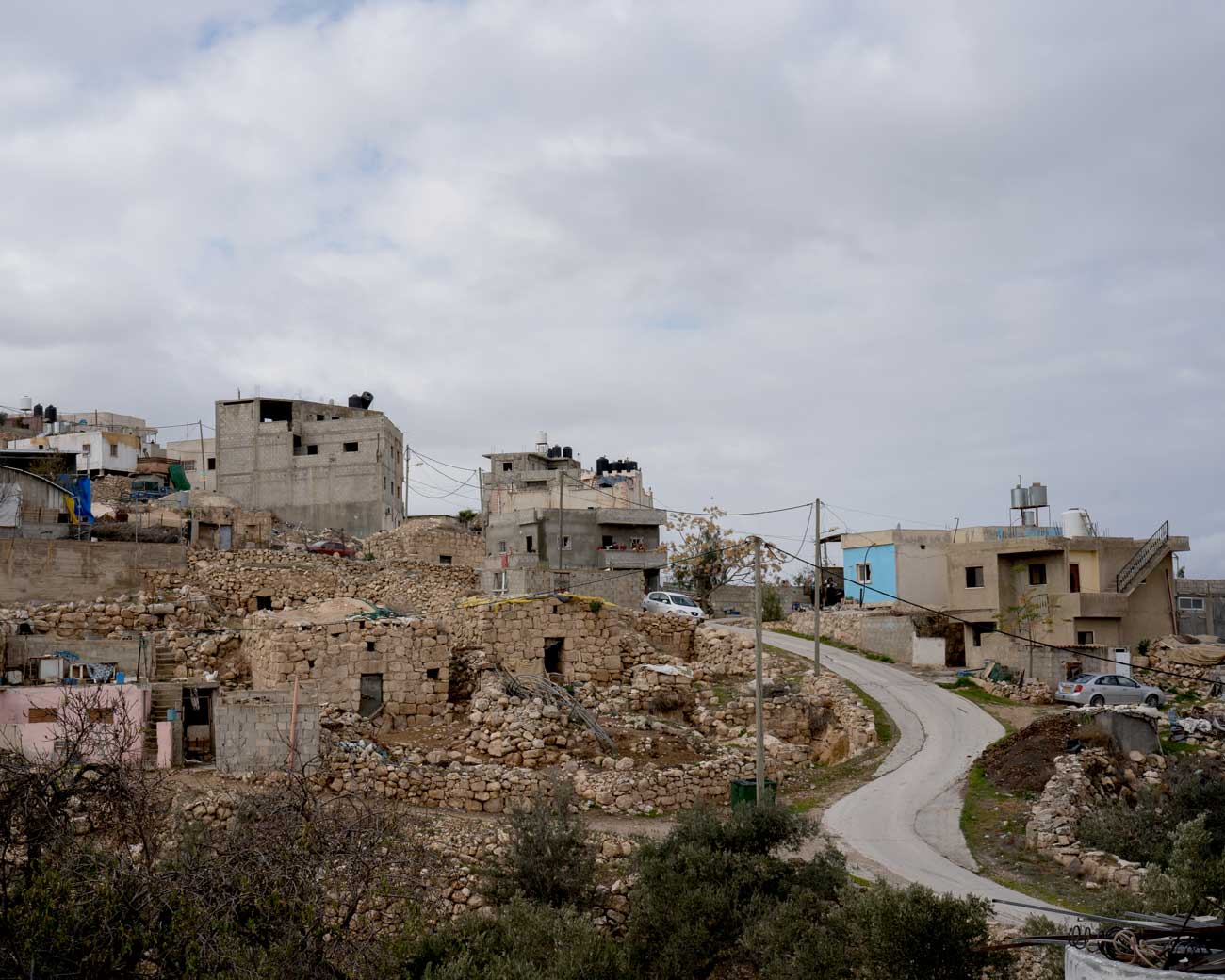
On Saturday, 19 June 2021, at around 7:00 A.M., a settler led his flock into Jum’ah Rab’i’s (48) barley field. When he noticed Rab’i, who was also grazing his flock in the area, he summoned about ten other settlers who arrived, masked, from the direction of the Havat Ma’on outpost and attacked Rab’i with stones in front of several soldiers. Rab’i was forced to move away from the area, and when a number of villagers joined him, the settlers threw stones at them as well.
After about half an hour, the settlers left, but returned half an hour later and stoned the house of Jum’ah’s brother, Amjad Rab’I (38), and his wife Liqyah (32). The settlers injured Liqyah Rab’i, who was standing on her rooftop, and Amjad’s mother, Fatmeh Rab’i (72), who was sitting in the yard and could not escape as she is paralyzed. They smashed the sun boiler panels on the roof of the house and broke several branches of olive trees in the surrounding land. When they saw young men from the village approaching to defend the family’s home, the settlers fled. A Red Crescent ambulance came to the scene and its crew provided first aid to the injured women.
The settlement of Ma’on and the outpost of Havat Ma’on were established about 500 meters and about 200 meters from the Rab’i family’s home, respectively.
In a testimony she gave B’Tselem field researcher Manal al-Ja’bari on 28 June 2021, Liqyah Rab’i (32), a married mother of four from a-Tuwani, described the attack on her home:
I live with my husband Amjad (38) and our four children, aged eight months to 10, in a-Tuwani. The settlers attack our home so often that our children’s mental health is suffering. They wet the bed at night and have anxieties. They also refuse to sleep in their own rooms and insist on sleeping with my husband and me. They wake up a lot at night, crying and repeating what the settlers call out.
On Saturday, 19 June 2021, at around 7:00 A.M., I was standing outside the house when I saw about 10 masked settlers throwing stones with slingshots at my neighbors, in full view of about five soldiers who were in the area. The attack lasted about half an hour. At the same time, I saw setters grazing their sheep on another neighbor’s land.
After about half an hour, the settlers left. I went inside to make breakfast, but suddenly heard voices outside. I quickly went up to the roof with my brother-in-law (16) to understand what was going on. We saw about 10 masked settlers coming towards us. They started showering us with stones.
Meanwhile, my mother-in-law, who’s partially paralyzed, was sitting on a chair in the yard. I tried to climb down off the roof to take her inside, but I couldn’t because of the number of stones they were throwing at us. It lasted about 10 minutes, and Musa and I were unable to escape from the roof. We started screaming for help. Meanwhile, a large stone hit me in the right shoulder and I felt a sharp pain. My shoulder is still bruised, swollen and sore.
In a testimony she gave B’Tselem field researcher Manal al-Ja’bari, Liqyah’s mother-in-law, Fatmeh Rab’i (72), recounted how the settlers injured her:
On Friday, 19 June 2021, at around 8:00 A.M., I was sitting on a chair in my yard when suddenly, I heard my daughter-in-law shouting from the roof, “Auntie, Auntie.” She asked me to run inside, but I’ve been paralyzed since a heart attack I had seven years ago and can’t walk. I leaned on another chair in the yard and tried to hide behind a tree. It protected me from some of the stones that were flying in my direction, but one of them hit me in the right thigh and it hurt a lot.
About 10 minutes later, young guys from the village started coming towards the house to defend us, and the settlers ran away. Then an ambulance arrived to take me away, but I refused to go to hospital because I was afraid the settlers would attack again. The settlers came back in the evening and wandered throughout village land until late at night.
The settlers attack us all the time, especially on Fridays, Saturdays and Jewish holidays. It’s been going on like this for 16 years, but lately the attacks have intensified. They were especially intense during the war in Gaza, in the final days of Ramadan.